Friday, 15 August 2014

Post 28: TA Conference and other TA and Grad Resources on Campus

Last week an email in my inbox made me really look forward to the approaching new semester: The Teaching Assistant Conference (TA Conference), put on by the Learning and Teaching Centre is on again this year!!

Aside from being an awesome on-campus resource that helps organize everything from tutors to writing help to teaching tips, the Learning and Teaching Centre has been running this conference for a number of years. The conference usually takes place in the week right after the Labour Day long weekend, which is idea for grad students and teaching assistants, because tutorials, labs, and other TA-related work doesn't yet begin.

The layout of the conference is great: its agenda features workshops for both new and experienced grad students, with some specializing in the three main discliplines: the Humanities, the Sciences, and the Social Sciences. As well, a few of the workshops are specifically designed for international graduate students who are TAing.

Tuesday is the most important day for the conference. It's a day stuffed full of presentations and concurrent sessions; there is a less busy schedule on the subsequent week days.

Two years ago when I was first starting my program, I attended this conference, and my experience was very positive. Certainly, I felt more prepared going into what then was a completely new experience. Some of the most memorable workshops were one on the many different kinds of icebreakers one could run at the beginning of a class to get students (and you) to know each other. I usually employ an altered a game that I played years ago in high school theatre class, but the workshop was great for getting me to think about different class sizes and how one can use the appropriate ice breaker.

Another one was specifically about being an introvert and TAing, and the kind of personality one brings to the classroom. I'm sure we all know the jokester, or the super engaging, humorous teacher or professor that knows when to crack the best joke, and how to include tastefully funny comments in their presentation. That isn't me, and it's stressful enough, sometimes, for me to be in front of a class (that is improving, however, with practice). The takeaway I got from there? Don't worry about being someone you're not; be your usual, quiet self, if that's what you need to do. You'll be engaging if you bring your excitement and care, and students will be understanding. They will know if you're being sincere and have their interests and learning experience in mind.

If you're around during the first week of September, I highly recommend attending!
Updated note: The Department is having their retreat on Tuesday, but even if you miss the first day of the conference, attend the others! There are numerous sessions that take place all throughout the week.

                                    When every stick looks the same, it's good to know which
                                                          resource will serve you best!

Aside from the TA conference right at the beginning of the semester, there are always a number of other resources available for graduate students on campus. This short list is a few of the main ones:

The Writing Centre (soon to become the Centre for Academic Communication), whose tutors will sit with you one-on-one to discuss your writing, ways to self-edit, revise, etc. They also conduct workshops throughout the year on everything from planning your research, to writing it up, and presentation skills.

The Halpern Centre for Graduate Students is also a great place to spend a bit of time, have a pint and/or a meal, and meet to discuss ideas with fellow grad students.

                              Another of our local beauties: common camas (Camassia quamash).

The Thesis Completion Group, run through Counselling Services, is a supportive undertaking that helps students to complete their theses! Maybe the best part is the camaraderie of understanding peers finding their way through academia, and the great listener and advice-giver that the organizer, Janet, is. The TCG also covers some practical things like time management (Pomodoros!), goal setting and planning, offering tips on the best resources for writing your thesis and dissertations, managing relationships with supervisors, and overall, just providing an open, supportive space.

CUPE 4163 is also the union the TAs belong to, and are a resource for all things work-related for TAs, including working conditions, interpreting the Collective Agreement (the rules that govern TAs' relationship to the university, and everything from breaks, to sick leave, to training...). They also have access to mediators and legal professional help if there is a need. Their blog features a number of up-to-date articles and issues that affect academia as well.

Thursday, 7 August 2014

Post 27: Best (By this, I mean Useful**) Thesis Advice So Far.

This post is written with the desire to give a nod to all the supportive voices and folks that have helped me weather my ups and downs along the way. I want to share some of the best advice that I've been given or encountered along the way. Positive reinforcement, right? This is necessarily a partial list because I have a poor memory and have undoubtedly forgotten some of the advice, or haven't written it down, and—I'm not done yet! So more will probably be coming.

1. "Best foot forward, one step at a time." This from the Buddhist philosophy of non-attachment. Let the hard things be hard. Each day that you start, the conditions will be different; you might have skipped breakfast to sleep in a bit more, or your cat got spooked at 3AM and rattled you out of your sleep, and you had to spend half an hour figuring out what happened, and calming the cat. So, begin each day fresh, with intention, and starting with goal setting as you go, based on how you think you can work that day.

2. "A master's is more about learning the skills than coming up with some genius discovery." This is classic Jenna, with her pearls of wisdom (slightly paraphrased).

3. "No fear!" from my supervisor. :)

                                   ...and then I can just be glad I live in this awesome place!

4. "Keep it simple, and as you go through your degree, pay attention to the realizations that suddenly become obvious to you." That's where you'll find the results and insights that you'll be writing about, but because they will also become 'obvious' to you, you may have difficulty reminding yourself that those are your findings, and that they are important to report. -- Karen, my awesome work buddy, office sharer, who also teaches as a sessional instructor, on research methods and methodologies in social work.

5. "The first draft of anything is shit." Thank you, Ernest Hemingway. :)

6. The advice from my supervisor was to find someone in my field, to talk to, and discuss ideas. There's nothing worse that can come from a poorly timed talk from someone doing different methods, using different ideas, than you are, that can make you panic and think that you're not being diligent. I'm sure every grad student goes through some point where they're gripped by the fear of not reading enough, or widely enough. So, talk it out with someone who shares your methods (or very similar ones). I can't thank my colleague Garrett enough for all the conversations and discussions over lunches sitting outside our building in the sunshine this summer. So good! He's also doing science studies research, and is certainly a bona fide social scientist in the making. And, we've discussed everything from specific methods and approaches, to how to write up a lit review. So good.

7. Effective procrastination: this from Laurie Waye's "Managing your Thesis or Dissertation: A Workbook for Students." Essentially, she points out that ineffective procrastination is when you are supposed to do work on a certain thesis something, but instead you go do the dishes, or fold your socks, feeling guilty and spending precious mental space beating yourself up because you know you should be doing thesis work instead. Effective procrastination is when you are unsure of how to proceed with say, starting chapter 2, or beginning the summary on that book, so, you go for a walk to clear your thoughts and think about how to start. Or, you have questions that arose from the last article you read, so you need to think them through a bit more, so you go for a walk to do so. You're still spending time working (thinking ideas through), and you're still focused on what you have to accomplish. Win, win!

8. From my lovely committee member: on tackling the imposter syndrome: don't take yourself too seriously, and approach all of your work with a bit of humour. :) AND—send stuff out. The more feedback you can get, and the sooner, the better. (Obviously the things you do send should be in pretty good shape, but yes, getting something to your supervisor is probably a good idea!).

(P.S. I'll come back and update this post periodically, as more 'best advice' comes in; if it gets too long, I'll break it into two posts, but that's maybe less likely at this point. Stay tuned!)
(**P.P.S. Each of us needs different advice at different times. If you have a pocket of time, and someone hands you a novel, you may just take it. If you're already curled up in a chair in a library, with three books on a table beside you and your imagination buried in the book in your hands, you might accept it, but it might also be refused. I've certainly noticed that some things said to me earlier only make sense now, looking back over the various phases of the thesis. So, take the advice above in stride, you might not need to hear some of it yet, and for others, it might just be the right thing, whereas next week, you'll notice it's no longer useful.)

Tuesday, 29 July 2014

Post 26: Awesome Office Spaces

Okay. Just today I arrived on campus and walked to my workplace near Mystic Vale, and hear the keening of two hawks that live near my partner's workplace. Who knows what they were up to, but they seemed to be having a time of it.

Next, it's lunchtime, and I usually pull out a chair to sit in the sunshine in front of my building, taking in a good bit of fresh air and sunshine (I usually sit behind a computer for most of the day, looking out at the lush maple trees right in front of my window). I look right, in response to the strange scrabbling sounds, and see a squirrel making it's way up a tree trunk, it's tail helping it climb, though it also looks like the squirrel has a giant inchworm attached to its butt.

I look left, and see a barred owl in the maple tree by the office corner, lazily turning its head and looking around, swivelling in that 360 viewpoint that only owls can manage. I point it out to my colleague who joins me with his soup, moments later. He also just missed the leaping and bounding wiener dog that was chasing a red bouncing ball down the hill in front of our workplace. Pretty darn cute.

                                       Our office barred owl! Just down the way, on the path.

Just before my partner comes by for our brief walk (we do this once a day for our breaks, to counter the detriments of sedentary lifestyles), I fill up my bird feeder. I regularly get house finches, brown-backed chickadees, nuthatches, and even have some towhees and junkies that seem to have learned about the rewards of leaving the ground to find a roof-top high snack!

Twice last week, and for 4 days this week, I have been and will share my office space with a colleague who doesn't have her own. Her admiration of this old house, and the phenomenons of having push button light switches and latch-windows and all sorts of other neat features in this house, reminded me of how fantastical it was to move into this space, almost a year ago now. And, it also makes me more grateful for a wonderful office space, that is a treat to have a space to get to, relax, throw down my books, or get away from the construction noises that have been taking place outside my apartment for over a year now (I keep forgetting about that, until I spend a short few hours in my apartment when I would usually already be on campus).

My laptop is my main and only computer, and I have a big monitor that I connect it to, set to be the right height and distance from me when I'm sitting, working at my desk. I also removed the arms on my chair to promote better posture, and also in the vein, have a keyboard and mouse that I connect to my laptop, so I don't slouch down to type. As I wrote earlier on my blog, it's good to have the ergonomics set up properly, and stick to using your equipment well so that you don't end up with repetition-injuries like the one I had with my shoulder.

Having a great office space is wonderful, but having it set up for productive work is necessary. I will admit I sometimes get distracted by the birds that visit the bird feeder suctioned to my office window. :) And, of course, watering all the plants is a must.

Friday, 25 July 2014

Post 25: The Impostor Syndrome

Okay, so I just wrote my last post mentioning the Impostor Syndrome, but realized that I haven't actually written about it before.

The Impostor Syndrome is a psychological phenomenon (not an illness or disease), whereby "people are unable to internalize their accomplishments" (thank you, Wikipedia.) It's oftentimes linked to the Dunning-Kroeger Effect, which I've posted about a little bit, here, right at the beginning of my blog. I've now convinced myself that the Dunning-Kroeger Effect is the positive, wonder-full closely-related flip-side-of-the-coin to the Impostor Syndrome, because when I'm feeling positive, and on top of my game, I really feel inspired and excited by recognizing that there is so much out there to read and learn and be exposed to, and so much that I don't know. Hundreds of years of other people's ideas and expressions and arguments and lessons and wisdom. It truly is an amazing time to live in, with the internet and interlibrary loans and blogs and journals, and being a part of academia. And then, when I'm feeling the full brunt of the Impostor Syndrome, all of that wonder kind of falls away, and instead those people or ideas who I admire, become unreachable, and become objects of terror and interrogation, because I might not be fully understanding them, or might be getting them wrong, and those are skivs that can be dug into my identity, my sense of being, and can be used as objects to prove that I don't belong where I am: that I am a fraud who doesn't deserve to be at this institution.

That is the Impostor Syndrome: that cycle of thoughts that tells you: You don't deserve to be in the program that you are, to have the position that you got, to earn as much as you do, to get the funding that you did, etc. And you feel like somewhere, someone is going to call you out for it, is going to embarrass you, is going to show the world that you really don't belong, and didn't, the entire time.
While discussing the sometime crippling tendencies for perfectionism in her awesome workbook for grad students, Laurie Waye employs the useful metaphor of the Cinderella Syndrome: "where you're at the ball (i.e. graduate school) but you don't really belong there. You're worried about being found out for who you really are..."

Reading on the Wikipedia page, I am not surprised to see that it was women (Pauline R. Clance and Suzanne A. Imes) who first began to do research on this phenomenon (their article was published in 1978), and showed that high-profile, successful women exhibited this phenomenon, believing that they were over-evaluated by others, and were not intelligent (Wikipedia).

Since then, a number of high profile people—not only women—have admitted to struggling with this phenomenon, including an actress and humanitarian who I highly admire: Emma Watson, who was recently named to be the UN Women's Goodwill Ambassador, and others like the formidable US Supreme Court Justice Sonia Sotomayor and the writer Neil Gaimon. Other common demographics of people affected by it include (surprise!) graduate students, the beneficiaries of affirmative action (who think that they are chosen because of these 'exceptions', instead of their skills or abilities), and generally, successful folks.

Now, the tough part is that there is no 'cure' or solution for the phenomenon. The best thing to do is to talk about it, and be aware of it. To identify it. I know that I am grateful that it was discussed and mentioned by the staff person from Counselling Services for the graduate student orientation that took place right before the official start of my program here at UVic. I had never otherwise heard of it before, and certainly never felt it as strongly as I have over the past few months, during undergrad. One suggestion was to write actively about one's achievements, and while I don't think of it that way, one of my motivations (when I was writing excitedly about the Dunning-Kroeger Effect) was to keep track of all the wonderful things I get to do, experience, be a part of, during this graduate degree. Some of that includes marvellous things that are celebration worthy, like receiving great funding, and attending amazing conferences, and getting to spend time with brilliant colleagues and professors and ideas.

So, we need to be gentle with ourselves, and supportive of others. We need to take the positive side of competition, which is to help us become better people, and in this case, budding academics. Cheers to positive learning!

Sunday, 20 July 2014

Post 24: And then there are days...

... when it seems like you can't get anything done, and truly are your worst enemy. The logic goes something like this: "Well, I can't start writing this, because I'm not done with that part of it; where do I start then? But oh, can I do that? What if I can't do that? Is this the next best thing to do? I don't know if it is, so maybe I won't start there. Okay, so because (I think) I don't know what to do here, I'll just skip to the internet and poke around there..." And after an hour or so of reading news articles, and beating myself up for doing so, instead of "getting work done," I start to feel like I'm a fraud and a cheat, and like I don't deserve to be here, and I'm a fake, because surely this can't mean 'doing research.' And someone's going to call me out on it. Well, the reading articles on the internet sure isn't, unless they're vaguely linked to your thesis, but frequently they aren't. But thinking about novel ecosystems and the social construction of nature and how scientists study the mountain pine beetle, in my case, very much is! So much of doing qualitative research is iterative, with learning happening at various points and stages, some unpredictable, and there's always a gradual, almost imperceptible set of changes around the ideas that I'm forming, that my biggest job, sometimes, is keeping track of those changing ideas.

So, we all have bad days where we psych ourselves out of being able to get things done. I woke up with a headache this morning (which on its own, doesn't happen often), and that certainly doesn't help.

                                                   It might as well be raining indoors...

I think when we get into these ruts, I go back to making really simple goals, small tasks, starting from somewhere, because it's definitely better that getting stuck nowhere, with the Impostor Syndrome and the cycling, downward spiral of the psychological game that that is.

And, it's not easy to deal with at the best of times. I've been having a lousy work week, and finally yesterday I had a brief blip of light: I received a letter in the mail (an unexpected form for the message I was waiting for), that I had been appointed to the Environmental Advisory Committee of my local municipality. I had applied for this position via email over a month ago, and was waiting to hear. It was great news. I certainly think there are limits (and perhaps dangers) to depending on outside reassurance that I am capable and competent, but for now, it certainly is helpful. But a personal, ongoing project will need to be learning how to internalize my successes and achievements, so that I don't need to start from square one all over again. I am competent, and can achieve things, and be a part of something bigger than myself, along with other people who care about and share similar goals as me. Recognizing this doesn't mean that I can't be wrong, or can't make mistakes; all of those places are opportunities to learn something. With enough evidence and good arguments, we should always be open to changing our minds.

                                       Could definitely use one of these and a cup of tea....

So. Here's to heading back to my follow-up interviews and having a good go at them.

Friday, 18 July 2014

Post 23: Manuscript or Monograph Style Theses?

Somewhere in this process of undertaking a master's, this conversation starter came up: to do a manuscript or monograph style thesis? What's are they, what's the difference, what are the pros and cons of doing either (as I've encountered them so far...).

Well, to some extent, your thesis supervisor will have a lot of input into which one you write. Your specific topic and research questions will also influence the form that the thesis should take. Do you have two very specific and different research questions? It might be most suitable to tackle both in an article each. Or, if you have a bigger, over-arching research questions with a few subsidiary questions, it might be easier to tackle as a monograph. OR, it might just be the legacy of your supervisor's research group that manuscript or monograph styles are preferred.

In general terms, here are the differences between the two, and good things to consider:

Monograph style: 

For this thesis, the chapters are styled similarly to a book. Chapter 1 will be an Introduction, Chapter 2 the Literature Review, Chapter 3 will cover your Methodology, Chapter 4 will cover your Results/Findings, Chapter 5 will be the Discussion/Conclusion of your findings. (Or something to that effect; the chapter numbers and contents can be shifted around with some flexibility. For example, Chapter 1 may be a combination of the introduction and literature review, and chapters 5 and 6 may take on the discussion and conclusions separately.)

The idea behind a monograph style thesis is that it's a chance for developing a long, fully fleshed out argument that provides an answer to the research questions that motivated the undertaking. As my supervisor promoted the form, he pointed out that we don't see this kind of long-form argumentation very much any more.

Benefits: This form is relatively easier to write than the manuscript style. It's also easier to transform research written in this form into a longer book-length publication.
Drawbacks: This form means that there is a bit more footwork to be done if you're turning your research into a journal article or two. More rewriting and restyling later down the road.

                              Quick break for flowers - these live on campus by the UVic Bookstore.

Manuscript style:

For a manuscript style thesis, the format will take shape something like this: Introduction, Methodology/Methods, Article 1 (with it's own Introduction, Methods, Findings, and Discussion), Article 2 (with it's own Introduction, Methods, Findings, and Discussion), and Conclusion. Each of the articles is styled like a journal article or pretty close to it, each beginning with an internal introduction, content, and conclusion.

As is covered in a different post, there are a few different kinds of journal articles, which my colleague Dr. Garrett Richards illustrated here. From what I've heard from a colleague, it's become trendier to write original research into a manuscript style thesis because this increases the chance of publication. Some of the 'chapters' in this thesis may be labelled with the monograph style headers, but the content can be quite different. So, Chapter 1 will be the general introduction, Chapter 2 will be article 1, Chapter 3, article 2, Chapter 4, the conclusion. The introduction and conclusion in this thesis style need to speak to both of the article chapters, and generally, the Introduction, Methods, and Conclusion will pull together the whole document.

Benefits: This form will relatively quickly line you up for publishing journal articles.
Drawbacks: Sometimes it can be difficult for new graduate students to translate their research into journal articles right away (hence the comment re: monograph style thesis above). Ultimately, these things seem to me to come down to time, and things you want to learn before you get out of the door.

The School of Environmental Studies, being a broad and interdisciplinary department (political ecology, ethnoecology, and ecological restoration being this department's three main pillars of research), certainly has students producing both styles of theses.

There also seems to be some departmental difference between the preference of thesis styles. In some, like biology (from what I understand) and other hard sciences, it is most common to write a manuscript style thesis. Sometimes the monograph style is said to be 'out of fashion', (and I've heard of a few stories where supervisors disparage the form that way) but again, keeping in mind what can be achieved with both styles is important, and will be helpful for deciding which will be more suitable for your work. Again, your supervisor will undoubtedly weigh in on this discussion. The goal for both forms of theses is to report your research findings; from there, it's choosing the best form. I think this is a good perspective to have: you will learn slightly different skills with either form, both of which will be valuable.

(PS: This post is not meant to be overly prescriptive: there will be differences among forms. A monograph style thesis may turn out with the results section being almost cut-and-past ready to drop into a journal article. Or, a manuscript style thesis still needs re-shifting, editing, cutting, to make the articles a better length for a target journal; depending on the journal, you may have a manuscript style thesis with two article chapters, each 10,000-12,000 words in length, but the target journals for each article have a maximum word count of 6,000-8,000 words. So, editing is still needed.)

As a graduate student, it is well worth the time to find theses from previous grads in your program. They can offer a guide and example of the kind that you'll be working towards. I've also found it extremely valuable and am grateful to the colleagues that have had long conversations with me about their process, tips, and advice. SO GOOD! :)

Monday, 7 July 2014

Post 22: Parkinson's Law of Procrastination and Pomodoros


Okay, so the law isn't necessarily directly tied to procrastination, but one of my colleagues pointed out that was a natural consequence of the law.

Parkinson's law (according to Wikipedia) is the phenomenon where work expands to fill the time available for its completion. People, who know that their deadline for a given project is in a week, will take the whole week to finish said project, even if it should have (and could have) taken less time. It's sort of a self-fulfilling prophecy.

Cyril Northcote Parkinson, British naval historian and writer, identified the phenomenon that carries his name in an essay he penned in 1955 for The Economist. Originally the essay that discussed the effect pointed out to the consequences for the efficiency of work, and since then, a number of further elucidated points arise, including this one, which more directly speaks to the point above: "The amount of time one that one has to perform a task is the amount of time it will take to complete a task."
And further: "If one waits to the last minute, it will only take a minute to do" (Pannett, Dines, & Day, 2013, p. 65).

This is what I feel I deal with as a graduate student all the time! Where, if I don't structure my day, or set myself small goals throughout the day, the amount of work and time spent being productive drastically decreases, because, Hey, I have the whole day to do it, right? (Without defining what 'it' is...) It's a trap!

                                  And then there are summer pine cones, looking pretty great.

In one of my recent attendances at the Thesis Completion Group, the organizer brought up the Pomodoro Technique, which are 25 minute blocks of uninterrupted, dedicated working time, split by 5 minute breaks (short) or ten minute breaks (long); or, a food break as you need it. The idea was developed by Italian Francesco Cirillo, who believed that taking frequent breaks led to better mental functioning and agility. Breaking up big blocks of time into these little patches of really concrete work time can be an awesome way to break up the day, and get lots done! (For example, writing a short blog post!) I've been thinking a lot more about how I structure my time and day since learning about Pomodoros, and I've found them to be quite effective, especially when I build them around bigger breaks or markers in my day, such as when I leave work, or take lunch.

So, if you, like me, struggle with Parkinson's Law, try a Pomodoro, or two, or three, and get to using your time to your advantage. After all, theses don't write themselves, and as a graduate student, you are your main deadline setter!

AND -- if you want to become a Pomodoro master, have a short look at this short video. There is also a book for the technique, but I don't think it's necessary to purchase. The technique as described above and in the video, are more than enough to start thinking about, and changing the structure of your time.

Wednesday, 2 July 2014

Post 20: Being Young, and Asking for a Better Future

One of the resounding messages that I feel I've been left with after the Impact! 2014 Youth Leadership in Sustainability Conference is that we need more stories that make sustainability come alive. And then I have a whole host of questions to accompany that: what does sustainability look like? How does it translate to someone doing something in the world? What possibilities exist for me in my position? How do I make sustainability and environmental issues generally, more visible for other people?

Since retiring from being a professional astronaut, Commander Chris Hadfield has been making the best of the skills and experiences he built in his career as an astronaut. And he is an amazing storyteller. I think griping people—as he did me—with stories about his lessons learned and unique perspectives because of looking at our planet from the International Space Station, which essentially embodies the 'pale blue dot' idea that Carl Sagan first wrote about, he has a lot of really valid things to say when it comes to sustainability, addressing climate change, and using human agency as a force for good in the world.
Gorgeous arbutus (Arbutus menziesii) on my walk down to Cadboro Bay.
I appreciate his storytelling. The talk he gave at the conference was immensely engrossing. All of this makes me wonder about the imagination that we currently have about the future of environmental and climate issues. Where do we see positive and useful examples of a different future? Who do we have changing our imaginations about what's possible? What do humans' actions on the planet and towards our ecosystems indicate for our values, and our general impact on the planet? What do we do if we find we're stuck in paradigms that don't work any more? How will people respond to "novel ecosystems," or assemblages of new plant and animal species that challenge traditional management techniques and ask us to examine our values when we look at the species that fill our waterways, backyards, and roadside ditches?

I think that we live in an exciting time. I am really intrigued by what the future holds: engineered ecosystems, novel ecosystems, adaptive cities. Dear world, please bring me the better future I'm looking for, where people and other species, animal and plant alike, get along a little bit better, share resources and thrive alongside each other. And in the meantime, I suppose I'll keep writing my letters, signing petitions, and asking for the better world that in glimpses, I sometimes see.


Monday, 30 June 2014

Post 21: Fieldwork Readiness and Prep!

This morning as I packed my bags for school, I was excited to head to campus to meet some of my colleagues and bring them a little surprise. Yesterday while grocery shopping I bought a big packet of Twizzlers (remembering that Mary loves them), and for those who might not be so into gummy strawberry-flavoured sticks, I got a couple Turtles and a packet of Smarties. I had a jolt of joy thinking about the delight I hope the gift will bring.
The summer is that time of year when a lot of graduate students head to to collect their data, and this summer is no exception for the School of Environmental Studies.

                           Throw-back to my time in the mountains: Hard at work writing field notes!
                                                        (Photo credit: Mary Sanseverino)

For some, this process started already a few months ago, and the halls of the buildings become doubly quiet: first from the undergraduate students that no longer visit professors, sessional instructors and teaching assistants during their office hours as classes find their end in April, and then when the grad students take to the mountains and oceans and communities in which they conduct their studies.

Last year I packed my rental vehicle and drove from the Kootenays to Prince George and back, and made another trip to Edmonton to visit the lovely folks that I was interviewing about the mountain pine beetle. I had my recording device, spare batteries, interview questions, my usb cards, a notebook, the casual professional clothing I was going to wear, my driver's license, money, everything I thought I needed for that trip. And, here's where maybe my best advice for going into the field: do your planning and prep for your field work as soon in advance as possible. You don't want to be scrambling in the last few hours before a big (or even small, but important) trip, sometimes to places where you'll have limited access to resources. For last year, my recording device, batteries, and interview questions were super key to the success of my trip. This year, being a supporter (a small one) for the MLP crew, I thought they needed some treats in the car on their drive; the rest was up to them. :) So, with that in mind, the other tips below are suggestions from when I spent time in the mountainous field with MLP, and the ones above, from my social science, qualitative interviews field work last year. Your approach is probably your best tool to being prepared. :) 


                                    Two great examples of being prepped for the weather: sandals for the
                                    black sand beach just outside of Hana, Maui.

                                              ...and sunglasses and a windbreaker to brave the chilly
                                              winds at 10,000 feet on top of Haleakala, Maui!

This year marks the two year anniversary since my field season with the Mountain Legacy Project (MLP), who were gathering their gear and packing the truck for this year's two-team outing!

My self-set task this year was to be supportive and to provide some tips; what's best to bring and pack when you're going to be spending 8 weeks in the mountains?

Some of my top suggestions for this work (definitely reminiscent of this blog post for MLP):

-earplugs (for entering and exiting the helicopters, when it's is so, so loud!! And, you never know when some bird will wake you at 5AM and you can't quite get back to sleep, or when a bunkmate might snore....)
-longjohns (it's several degrees cooler at elevation)
-fleece sweaters and a windbreaker and layers (frequently breezy, which affects core temperature due to abovementioned point)
-make sure to get enough sleep, eat enough food, drink and pack enough water
-take lots of photos and keep a journal to record all those special moments
-a hat, bug spray, and polarized sunglasses
-a couple of your own bandaids
-NO cotton; cotton gets cold when wet, and can contribute to hypothermia in the right conditions. Unless you're somewhere super hot and humid, you're better off with breathable, layered clothes that aren't cotton, in the mountains

Sorting out account log-in information for the blog has brought me into nostalgia mode: how fun that summer was, spending time with Jenna and Mary and the big big mountainous landscapes of BC and Alberta. Huge pockets of rain cells that you could see and avoid in the helicopters. The big shadow splotches of clouds on the forests and mountain sides, that bring texture and richness to a landscape's colour. The quiet. The buzzing insects, pollinating and zipping around at 8000+ feet, causing me to wonder how on earth they survive up there. The mosquitos and their ferocity (and the difference with being on the wind- or lee-ward side of a slope). The birds-eye view from the helicopter, and the bits of fun and banter with the pilots.

So much fun! Wishing them all the very best and a great field season for 2014!


Tuesday, 10 June 2014

Post 19: Impact! 2014 and Student Leadership in Sustainability

When was the last time that you stood in a room full of 175 people, knowing you could turn to any of them, and strike up an interesting conversation? For me, that was 3 weeks ago at the Impact! 2014 Youth Leadership in Sustainability Conference. WOW --- what a blast!

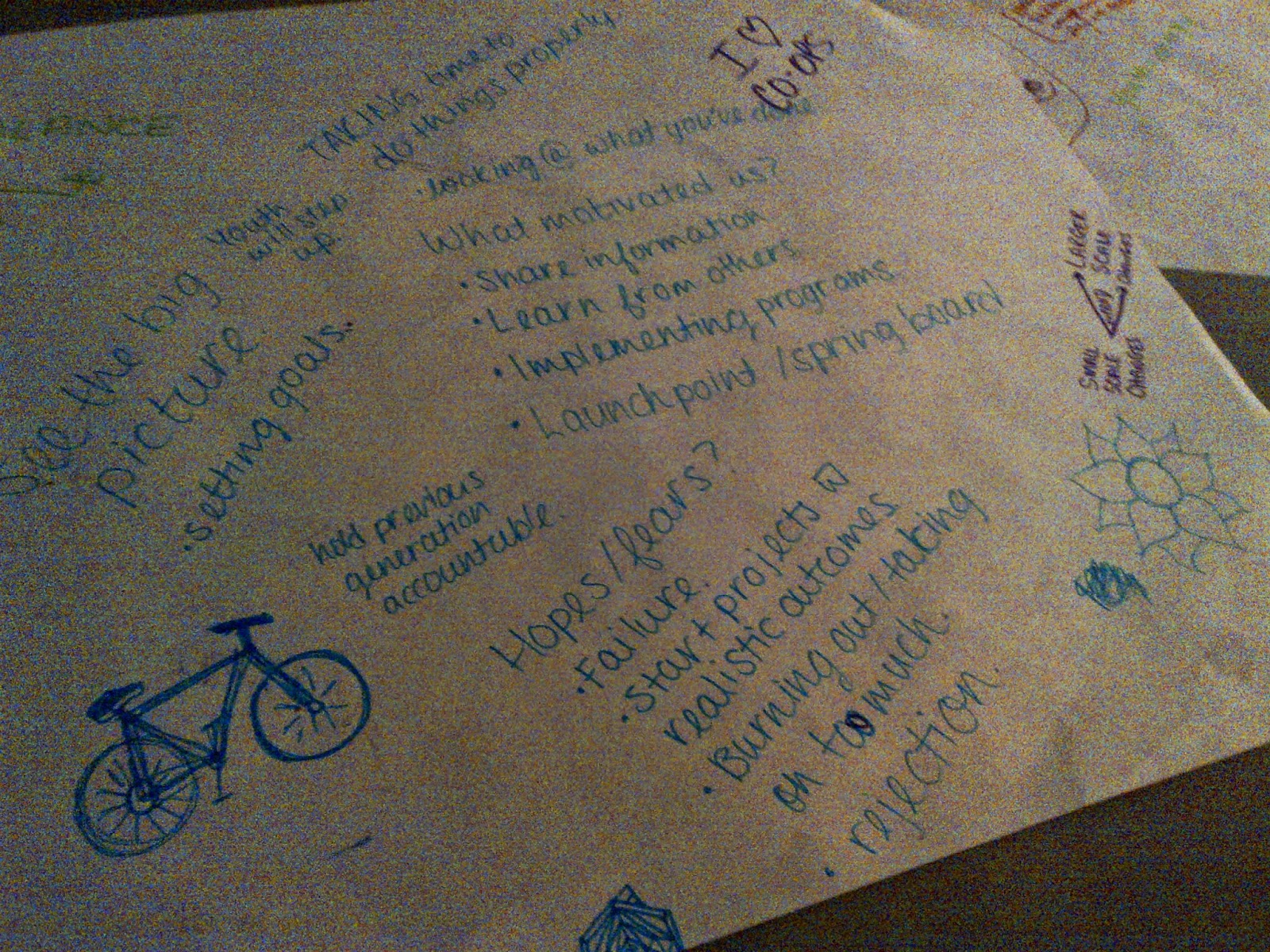
                                   One of many, many jottings and scribblings and ideas and
                                                collaborative discussions noted at Impact!

Even now, a couple weeks after returning from Guelph, I feel optimistic and recharged and amazed at the variety of ideas young people have for tackling sustainability! Alongside the boundless energy, optimism, and we-can-do-this attitude, there were hundreds of great ideas. Everything from a sticker campaign to try to get people to use only one sheet of paper towel in washrooms (which reminded me of these really powerful social media campaigns), to a national campaign on climate change education in schools by the symbolic turning off of lights for a day with the Lights Out Canada campaign to someone wanting to design a game-style app to help people keep track of and decrease their personal C02 use, to founding a cooperative, to starting a bike coop... and innumerable other brilliant ideas!!!

If you are a young person with a concern for the trajectory of the planet, apply to attend next year. It will change your life. I am so so so glad that I went. If you want a supportive environment, and be connected to funds that will help you carry out your sustainability ideas, go. (There is a fund you can apply for to help you undertake your projects, post-conference.)

For the rest of this post I'll talk about a few highlights from the conference, including the structure, but I won't be able to talk about all the good things; the post will get too long. I may return to this in the future again.

The conference was essentially a three day adventure of conversations and brain food.
We arrived Friday afternoon, and were shuttled to Guelph from the Toronto International Airport. We put our things away in our residence rooms on campus, then marched across the small campus to the hall where dinner and the opening panel was starting.

We heard from Elizabeth Thompson, the Executive Coordinator of Rio +20; Toby Heaps, the President of Corporate Knights Inc.; and David Miller, the CEO of the World Wildlife Fund. Each brought their own and wide-ranging perspectives on climate change, sustainability, and assessment of where we are now. From hearing about some very neat sounding ideas (like governments of the future having a Ministry of Tomorrow) and sharing nuggets of wisdom, like (I'm paraphrasing here), "For people who think the little things don't matter, just remind them of what it's like to be bitten by a mosquito." (This, particularly relevant for folks who don't think the small initiatives like petitions for social change make a difference.) And, as young people, we were encouraged to not let ourselves be ignored. Our voices count just as much as any CEO or voting citizen or business owner. We should not feel a need to apologize for our views and our concerns, and we should use the clarity of our visions to instigate social change, and ask for what we want in a better future.
Yes, a lot of it was a call to action, but it was also incredibly encouraging.

                                  We walked past the beautiful president's house every morning
                                               on our way to breakfast and the conference.

The next morning, up early. All 175 of us had been split into ten sustainability challenge groups; mine was Canadian Resource Development. For the first 3 hours of the morning we basically griped about what we disliked about the current energy systems in Canada. A lot of discussion about the tar sands and oil and gas production came up, a lot about pipelines, a little bit about coal, and then a number of comments about the systemic issues of how these energy systems are integrated into society, as well as the lack of support/progress with renewable energies.

The first few hours of the afternoon were spent imaging Canadian resource development 30 years from now. Where would we be? What would we have? How would society be organized around energy production then? All sorts of things came up. About have the comments were directly aimed at renewable energies that don't produce greenhouse gases (GHGs), and the other half were comments about social conditions, like having a functioning democracy, and bettering communication.

The last part of the activity was a two-parter: discussing which factors enabled and which factors disabled our current resource development from reaching that future state.
It was an awesome day, with a wide variety of comments. In my group we had students from engineering, and chemistry, philosophy and other social sciences—an awesome spread of views and perspectives that led to a really rich discussion. The name of this day-long activity: back-casting. You assess the current state, imagine a future (utopic) state, and think about how you can get there and what's preventing you from getting there.

The next day we had Commander Chris Hadfield come and speak to us. What an amazing speaker with a powerful message: collaboration can lead us to do great things, like putting an international space station (ISS) in the sky, and sending a man to the moon. He showed a number of images of the earth from the ISS, including one snapped of the great lakes and Guelph. You couldn't see that city from the image, but that was kind of the point. You couldn't see a lot of things from there: roads, houses, borders, security checks, etc. It reminded me a lot of Carl Sagan's "Pale Blue Dot" -- and the perspective that makes us realize we're all on Spaceship Earth together. It's us and this tiny little planet, hurtling through space at 25,000 km/hr, and so we better work together to make the best of our time here. His talk was really a call for taking personal responsibility seriously: if I don't choose to make change, then how can I ask someone else to?
Commander Hadfield teared up when we gave him a standing ovation. After 25+ years of being an astronaut, and much of it spent out of the country, he was really touched by our appreciation and expression of gratitude towards him.

                                    Commander Chris Hadfield receiving his t-shirt! :) Looks to
                                                                 be about the right size!

We had a World Cafe where people could bring forward project ideas and receive feedback from three different groups or students as we rotated through the hall; in the evening we also had an African drum session which was a great way to do something physical after all the brain work and thinking.

On the last day, we had wrap-up speech by Chad Park, the Executive Director of The Natural Step. The main two points he wanted to make were:
1. Believe. Be passionate, powerful, and know you are right.
2. Be empathetic. Listen. Know that you are wrong.
And he spent the talk unpacking what he meant by those two statements, including busting some myths about sustainability (such as it simply meaning to do 'less bad,' [it isn't, it's meant to be a movement of finding ways to do more good, and to help more people]) and encouraging us to call out people who try to get away with lazy sustainability.

Overall, one of the most important aspects of the conference was meeting a whole bunch of like-minded people who are so motivated to make change, that, echoing one of the rhetorical questions by one of the student leaders, I feel compelled to ask myself, What excuse do I have not to act?