Showing posts with label conference. Show all posts

Wednesday, 28 September 2016

Post 92: Effective Altruism and Grad School

Bit a hiatus from the blog since my trip home—I was ridiculously busy when I was there—but now I'm back, and determined to finish this thesis. However, before I speak more directly to thesis things, I wanted to revisit my trip to Berkeley for the Effective Altruism Global Conference I attended at the beginning of August. I've been thinking quite a bit about the people and ideas I encountered there, since. (I've just noticed that a significant number of the talks are posted, so go check them out!)

What's effective altruism? I won't rehash effectivealtruism.org's introductory essay about EA because you can read the whole thing here, but the general idea is to use evidence and reason to find the best way to make the biggest difference you can over your lifetime. If you're interested, I also recently co-wrote an introductory article to EA with Wray McOuat that you can check out here.

Gorgeous bougainvillea on a street in Berkeley.
So how is EA relevant for grad students? Well, we're pursuing training in a particular kind of skillset (research, teaching, critical thinking) that we will likely work to make a difference in whatever field we go into, so I actually think there's a lot of compatibility with pursuing careers (and an educative experience that emphasizes learning critical thinking, applying reason, and assessing different kinds of evidence for different causes).

A few words about the conference: as with attending conferences, it was an easy way to very quickly learn a whole lot, meet fascinating people, and test out my ideas—I also really love that the conference explicitly encouraged participants to seek out people with (on the face of it) opposing ideas, and to chat them out. Because of the conference I have radically changed my opinion about the effectiveness of giving money; previously I’d always held the idea that it’s better to donate time or creativity or energy in some way, but of course money is a representation of all of those things, applied in a particular way. At some point when your career is taking off, your ability to generate a decent income in a developed country can significantly outweigh the time and energy you may volunteer to a cause. And, if you're working full-time, you might not have the energy or time left over to donate. So, donating money can be a really good way to contribute to a cause that you support. 

Grand University of California, Berkley, campus architecture!
Having only once, for a brief period of time, made enough of an income to be classified above the poverty line, I have never thought of myself as being in a position where I could donate much, and so I don't think I had seriously considered it as an option, and my donating happened sporadically, to causes that I have come to believe are important (and still are), but I wasn't thinking about evaluating their effectiveness as much. The little bit that I gave, I did so because "it felt good." And I generally preferred to go volunteer my time or skills instead. Meeting a few people who were well into their careers and who didn’t have the extra time to volunteer, and who were proponents of such a method of doing good caused me to examine my beliefs about that matter. And then of course, the key is donating so to causes that are maximally effective. BUT -- I am still thinking about what this means for me, and I will revisit this in a future post. 

Dr. Max Tegmark delivering his talk via Blue Jeans, about 10 AI Safety Myths.
Further, what I think was particularly unique about this conference compared to others that I have attended, is that I found both very like-minded people, who described themselves as being altruistic and now working on the “effective” part, and also people who were very dissimilar to me: artificial intelligence researchers, philosophers, tech start-up founders, people who worked for various governments, or for charities and development organizations. People from the UK, from Australia, from the US, and all over. Such a diverse set of people!

And, Berkeley was beautiful as well. Overall, it was a phenomenal conference and I am very glad that I attended. Getting to talk to Toby Ord, an ethicist at the Future of Humanity Institute (Oxford) and really brilliant person, was spectacular. I had several discussions with Andy Fallshaw, CEO of Belroy, and am convinced he's one of the most generous people I have ever met: bright, charismatic, caring, and more than happy to make reading recommendations. On his advice, I'm currently looking at Douglas W. Hubbard's "How to Measure Anything," which I hope to discuss with my sister, soon. I definitely wish him well. 
Hike up to the Lawrence Hall of Science, which was really the coolest! 
I met several other tech start-up folks (EA is hoppin' in San Fran and has considerable overlap with the ambitious folks and business culture in the Bay Area), and the sense of ambition, vision, and possibility there was intoxicating for a little while. I didn’t get to speak with Will MacAskill in person, but hearing him talk was great, and there were free copies of his recent book Doing Good Better available. I devoured it on my return trip, and also learned a lot more about EA. If you're interested, I definitely recommend it as an introduction to effective altruism. There were a few awkward conversations, of course, because I found it difficult to maintain social grace at all times as an introvert, especially when I frequently found my energy bucket running on empty, but it was a good time overall.
From the Lawrence Hall of Science: A display of early cyclotrons: the things that smash atoms together. :D
Overall, I feel that the methodology and approach of EA is really a good one—and one to be applied more broadly than simply to EA. Using evidence and reason to figure out how to do the most good in the world appeals to me and speaks to my values. While I think there are still ideas to be worked out with how to measure and compare the effectiveness of different charitable interventions, the complexity behind undertaking such measurements is not without difficulty, and I am content that it is being worked on. Something to keep an eye on in the future. 


Happy September! Happy fall!

In my next post, I'll discuss the value of small successes along the way, to help build momentum and motivation during grad school.

Monday, 22 February 2016

Post 74: Graduate Student Opportunities at UVic

I'm blessed with a particularly active department that has seen a significant rise in the number of graduate students admitted in the last few years. With that have come several new faculty members, and a larger capacity to undertake various events. The seminar series that for my cohort's first year was optional has become a mandatory class component that regularly draws guests from other departments. Taking a leadership and organizational role to get it organized has been capably managed and supported by several different graduate students in my department, and it's really great to see.

Spring flowers on the front porch! Love the colours!
There are always lots of different ways to get different experiences other than simply attending class and doing research, and I think it's a good idea to explore different facets of academia to see if it's a good fit for you if you want to continue on as a graduate student, or in academia in general. Also, life experience! It's valuable, and as you work through different challenges you get to know more about yourself, even if it's as simple as Teaching is a lot harder than I expected or I need to work on my time management more!

Last year I saw an opportunity to join on as a graduate student representative to sit on UVic's Ethics Review committee. There are always emails looking for graduate students from across departments to sit on various university committee such as for the Senate, the Board of Governors, Excellence in Teaching Awards, Academic Accommodation and Accessibility for Students with a Disability, Childcare Advisory and many, many others. The Graduate Student's Society provides a good overview here. 

These lovely Chionodoxa luciliae have popped up in my neighbourhood the last few days!
There are also other ways to get involved. Did you attend a conference that you really loved? Talk to the conference organizers. There are usually things that you can do, even if it's as simple as talking up the conference among your colleagues back at your university. I attended the Northwest Climate Conference this past November (see my review post here) and after observing that there weren't many Canadians in attendance, and talking to one of the main conference organizers, I found myself stuttering to respond to an invitation to join the Steering Committee to work to get wider attendance. I haven't taken that on because I'm working on finishing my thesis, but it may be something I find I'm able to put energy into later in the year. I took on the logistics coordination role for CONFORWest 2014 (which I wrote about here), and developed a friendship with a colleague that I deeply respect and admire, and whose friendship I value greatly. 

Aside from the usual opportunity of getting teaching and marking experience through TAing, there are usually some research assistant opportunities, too. Talk to your supervisor and other professors in your department, as well as your graduate student advisor, as they likely have the beat on who's looking for a bit of research support. 

I loved the aesthetic of the leaves on this mystery neighbourhood bush! Fascinating!
And, there might also be some other closer-to-home opportunities like taking leadership on organizing your lab meetings. I did this last year, and it was a lot of fun! These kinds of administrative duties will likely colour our experiences, but they can also be productive breaks from data crunching and thesis writing.

If you are a teaching assistant on campus, consider volunteering with our union, CUPE 4163. There is endless energy and effort that can be poured into the union, which supports us in a lot of (often invisible) ways, from bargaining for our working conditions, providing arbitration support for graduate students with various grievances, to providing some travel funding for conferences. I took on a position as the Recording Secretary for a year, and have now shifted to a less demanding position as Alternate Trustee. We checked through the finance documentation in the fall, and that was me done for the 2015-2016 year. And it was a great experience! Currently, for example, they are in bargaining with UVic, and there's lots of help they could use with that! They also always have our Collective Agreement on their website, if you need to look something up. 

As always, I emphasize prioritizing your work, your health, and your needs, but if you have a bit of extra time, there are lots of ways to get both a wider experience in the university community, and be a part of building a richer community within your graduate experience. 

Monday, 8 February 2016

Post 72: Northwest Climate Conference 2015 -- An Overdue Review

This past November I attended the Northwest Climate Conference 2015 (formerly the Pacific Northwest Climate Conference), held in Coeur d'Alene, Idaho, a very cute little town that I hadn't visited since childhood on a trip with my grandparents. I attended in my capacity as a research assistant at Royal Roads under Dr. Johanna Wolf, a contract I've had for the past year. Excitingly, she was invited to speak as one of the closing keynote panelists, and I think her talk went really well! A significant number of the talks from the conference are available with this link here.

Beautiful clouds on the flight down.
Overall, the conference was great. I heard Bill Geer, the recently retired Climate Change Initiative Manager for the Theodore Roosevelt Conservation Partnership, deliver a talk on his travels through the Pacific Northwest to engage with hunting groups and associations—folks who can be a bit more politically conservative—to look at the observations they had already made about population shifts and range changes for many of the species they regularly engage with during the hunting season. This led to making some connections about the impacts of climate change where they hadn't, perhaps, before been made, and this is fantastic!

Overall, a nice component of the project was that it did connect practitioners and scientists, and I was really happy to see a group of high school students in attendance from the local school because of a really intrepid teacher. In retrospect, I have also been amazed by the seeming united front that some of the state governments and the federal government presence showed at the conference. We have nothing like that here in Canada, and the variability of the federal, provincial, and municipal governments' approaches and progress on adaptation is apparent very quickly. In the research project that we took to the conference, for example, I recall one local decision-maker highlight that at a recent meeting (Fall 2015), one of the mayors of a municipality with a significant amount of coastline had leaned in to ask this person if they had been thinking about sea level rise for their municipality, implying that he never had. This decision-maker was shocked that this municipality's main man hadn't thought about this issue before! 


Loved this little sand spit in I saw somewhere in the Puget Sound area as we got
near Seattle! It looks like a dinosaur to me!
While I skipped the Tools Cafe and opted for a short break from the conference instead, I did attend the Adaptation Speed-Dating event that took place at lunch time on the second day, offering a recommendation for how like-minded groups can communicate (not a new email or list-serve or newsletter, please, but tap into existing communications networks, and make connections among them). The crammed full schedule of the conference was certainly something to note: it was go go go, and after two and a half days I was exhausted! Definitely way to go on cramming a lot of stuff into a few days, because my brain was certainly filled to the brim with the new people I'd met, and the research I was hearing about, but sometimes I wonder if there isn't a better way to take in information at a conference.... 

In many ways, the logistics were fantastic: the size of the conference (no more than ~320 participants a day) made it fairly easy to find colleagues and speakers that really made me sit up straight and pay attention during their talks. And/or find people I recognized from the conference when I attended two or three years ago. On the note of colleagues, however: myself, Dr. Wolf, and Stephen Sobie, the Regional Climate Impacts Analyst at the Pacific Climate Impacts Consortium (UVic) were the only Canadians in attendance! I spoke with a few of the organizers about this, and realized that there was a very big opportunity to extend invitations to a much wider group of my Canadian peers and colleagues who would be interested in attending, and an invitation to help do so for the next conference. Take note: those of you interested in climate change, mitigation, and adaptation issues: they don't stop at the 49th Parallel, and look for the 2016 Northwest Climate Conference held in either Seattle, Washington.
I took this as a friendly reminder that yes, my country (The North Pole) is not that far away. :)
There were certainly a number of themes that resonated from when I attended the conference 3 years ago. This year, as in the past, there was much discussion about precipitation and responses to climate. The running hypothesis and projections seem to point to there not being significant differences in precipitation amounts in a warmed climate for the Pacific Northwest, though the form of the precipitation will likely change, and this will have significant downstream impacts. On a few different occasions: "Rain is good, but snow is better!" was stated, and it began to sound a bit like a conference slogan.

Unlike rain, snow extends the seasonality of moisture because of the length of time that snow can last into the year from when it first falls. Rain falls and needs to go somewhere, or be used at once. It has an immediate effect on local hydrologic cycles, while snow has a more prolonged effect. Snow takes longer to melt, and lasts into the spring and early summer, which has directly relationships to timing of peak and low stream flows, and the availability of water for cities, animals, and ecosystems. Snow is a central component of the water cycles in the northwestern states (and British Columbia, too!), and its worrisome that we are seeing snowpack decline, as Phil Mote and colleagues first presented in their 2005 paper "Declining mountain snowpack in western North America."

My first real frost of the year! It came decorating these leaves with beautiful sparkles!
Probably one of the best talks I went to wasn't actually a talk: it was a hands on, adaptation mini-workshop that was hosted by the Climate Impacts Group (CIG), which led us through four key stages of an adaptation planning process for projects that we had on the go. It is the same one that they use with clients to think through various aspects of adaptation. It was very very good.

We were encouraged to tweet (#nwclimate2015) about the conference and while we were there—which was a fantastic idea, and made me think of the positive attention that Canadian researcher Catherine Scott received around Halloween this past year, live-tweeting with grace and humour about the spider sex she was gathering data of in her lab—but to avoid major roaming fees on my cell, I'd left it at home. That made me brainstorm about how to make something like that more accessible for international attendees like me. Maybe guidelines ahead of time about tweeting abroad (using the wireless network) or having a cell-phone share or something like that from a general account for the conference? (My sincere apologies if I am revealing my lack of technological understanding here.) :) But I really appreciated the encouragement to extend the impact of the conference and interest in it through social media while I was there.

Mudgy the Moose; Millie the Mouse is, unfortunately, not easy to see in the dark!
Aside from the intellectual party that the conference was (I really enjoy learning about what research is currently being done and really on the edge of pushing our boundaries of knowledge), it was also a great way to explore a different city in the Pacific Northwest. I went for a lovely two midnight walks along the World's Longest Boardwalk, which extended as a floating boardwalk around their main boat dock area, and met the a few of the local Mudgy the Moose (shown above) and Millie the Mouse statues in town, which mark their walking trails. Overall, it was a great trip, and I hope I can attend next year's conference again.

Thursday, 11 June 2015

Post 52: Charlottetown, Climate Change, and the East Coast!


I was lucky enough to be able to attend the Climate Change in Culture Conference put on by the fantastic group at the University of Prince Edward Island (UPI). What a phenomenal conference!! And three cheers to Dr. John McIntyre and his co-star Jordan McIntyre -- it was a delight to be greeted in person, by name, at the conference registration table, and while I didn't see John's presentation, I was immensely intrigued by Jordan's, which covered "The 'Scandal' of Climate Science." 

Bit of background (just in case this is new news for some): since September of last year I've been working part time as a research assistant for a climate change and adaptation project led by Dr. Johanna Wolf. Partly for experience, definitely for interest and concern, and partly for helping to keep me in Victoria while I finish up my mountain pine beetle thesis. 

Our project budget allows for sending us to a couple of conferences, and Charlottetown was the first that we went to to present some of our preliminary findings!! SO MUCH FUN! I really loved and appreciated the collaborative building of the presentation with Johanna as we prepared for the conference, even if it had us making edits after 9PM when we should be getting ready for bed after a long day of travel! :) But such is the nature of the work sometimes. 

One thing I did not expect: the challenge of the timezone difference! PEI is 4 hours ahead of BC. So when it's 10 PM in Charlottetown, it's 6PM in Kaslo. And my body was not able to adjust to a reasonable bedtime because my internal clock was not having it! So I had several nights of 2AM because I couldn't fall asleep. I ended up getting a chest cold after the conference that's still clearing up, and between the hours of sitting, perhaps not eating as much or as well as I usually do, and the stress and excitement of the conference, my immune system was down for a bit. Whammo: enter the chest cold! Ah well. It is definitely easier going west with the timezones than it is going east. 

The Parliamentary buildings in Charlottetown!
And for the first time I met an academic that I was super excited to meet -- Dr. Andrew Light! He was one of three keynote speakers. I had read some of his older work, and he was an author in the Novel Ecosystems textbook that I've had my nose in for about 2 years now.  A philosopher by trade, he's on leave to serve as a Senior Adviser to the Special Envoy on Climate Change in the US Department of State. The talk he gave really put into perspective for me what we can expect of the climate negotiations later this year in Paris later this year. I feel slightly less pessimistic about the prospect of countries getting their act together to address climate change (both mitigation and adaptation) in light of the heavy-weight institutional infrastructures that need moving in order to get that action going, before we're really committed to serious warming beyond 2 degrees Celsius. 

So much love for the colourful houses in PEI
The presentations were fantastic, the topics wide-ranging and interesting, and I definitely feel like my brain got stretch in a really pleasant way. What really struck me after listening to presentations for several days, was how different the presentation formats were. I'm not saying one was necessarily better than the other, but I was surprised by how many people read out their papers, as opposed to focused on standing-up-with-a-slideshow-and-presenting-their-material-that-way that I've come to expect. While all the presentations were quite good, I found the read-aloud presentations were more difficult to engage with, and lacked slides for some of the basic things such as the names of the people they were talking about. I suppose that is feedback that I'd give some of the presenters, especially because this was a multi-disciplinary conference, and as some with social science training, I found this to be a barrier to fully enjoying and maximizing my understanding and engagement with some of the presentations outside of my discipline. As well, I feel it would only be fair to acknowledge that I am a visual learner, too, and so am definitely someone who benefits from both seeing content and hearing it. 

Conference Field Trip!! 

We had one, and it was fantastic, and it really brought home for me how different climate change is affecting both the east and west coasts of Canada, and how much warmer the Atlantic ocean is than the Pacific. 

PEI is an island made mostly of softer materials: sand and limestone. It's already experience a fairly significant amount of shoreline erosion; one local and well-known story that Erin Taylor ( Department of Environment, Labour and Justice, Government of PEI) mentioned during her talk (fantastic panel on Climate Change, Land Use, and Planning on PEI) was of a resident who still pays about a dollar a year in property tax on the 99% flooded lot that he still owns, which has been in his family for a while. But it is gone! It's underwater! Only a corner of it remains. 

PEI and Charlottetown apparently had a significant scare with Hurricane Sandy a few years ago; early projections for the path of the hurricane had it set right for the middle of PEI, and the storm surges would have been massive! Hope Parnham (Dv8 Consulting), another presenter, shared that this is when the city really woke up to realizing how under-prepared it was to deal with some of the extreme events that Charlottetown can expect in a climate changed world. [[Sidenote: It's not that the numbers of hurricanes are increasing, but that their paths of travel are changing: they're heading further poleward, as seen with Sandy, and their intensity is increasing (thanks for the science brief PCIC!!). Sandy fortunately changed it's trajectory a bit, and was downscaled to a tropical storm by the time it hit Charlottetown.]] It was fortunate that Hope was able to pull together some of the recent work she and other had been doing to get some really quick progress done with the municipalities and government to think about and through what it meant to prepare for climate change. 

So with all of that in mind, we headed for a beach walk, led by the local climatologist Dr. Adam Fenech. We boarded the bus to Greenwich, and half an hour later, ended up at the North Shore of PEI! The beach looked like this, and it was spectacular: 

Warm winds, talks of bees and farmers with a fellow conference-goer on this red-sand beach; deee-lightful! 

The winds were warm, the company was excellent, and I really fell in love with the Island. I bumped into Dr. Roger Wheate from the University of Northern British Columbia who I'd met at the Thinking Mountains Conference in Jasper only 3 weeks earlier (so heartwarming! Many hugs!). I also bonded with Dr. Laurie Brinklow during that walk as well,  who kindly shared her book of poetry with me (I'm currently reading and enjoying it!). Hers was the first story I'd heard of someone from out west and in British Columbia that went east, stepped onto PEI, and said "This is home." I'm used to hearing stories happen the other way around! 

Charlottetown is a wonderful small city. I stayed in a hotel right on the harbour-front, could walk up the downtown main streets that there were, and in retrospect I'm amazed that it's a city of about 35,000! It didn't feel like it at all. And everyone was friendly and kind and helpful when I needed a hand with directions. The buildings are similar to what they are on the UVic campus: few tower about tree height, so everything feels nicely on an engaging human scale. 

The Charlottetown waterfront, though my view was slightly different, and sans the cruise ships. 
I definitely wish I'd had more time to explore and take in the city. Many thanks for the meals shared, conversations talked, and thoughtful engagement with a number of others at the conference. I almost got to meet everyone, and it was very, very rewarding to do so.

Short note: unfortunately my phone battery died, and as it was my main source of photo-taking, I will need to post some of the few photos I snapped later when I get the new battery mailed to me. The photos I used on this page are sourced thanks to the Internet! 

Friday, 22 May 2015

Post 50: Thinking Mountains Conference Recap

The Thinking Mountains conference held in Jasper, Alberta from May 5th - May 8th was one of the most fun conferences I've been to.

The size (around a hundred?) was perfect for getting to know almost everyone I'd wanted to (at times the conversations among other delegates were so engaged that I missed talking to two people I'd wanted to say hello to!), the venue and food were fantastic, and the mountains surrounding Jasper made for more than a fitting locale for the conference. The weather held up, too! It was great for the majority of the conference, and we delivered a successful Mountain Legacy field trip and managed almost all of the photos at the Old Fort Hill station as part of a Morrison P. Bridgland survey.

A photo that the talented Mary Sanseverino took of us at the field trip with our group! It can be found on her Flikr here.

What a great bunch, and what a fun afternoon! In the image above, Mary transposed the historical survey photo (in black and white) onto the modern with us in front.

So this was also my first conference with almost my whole lab group, and that made it really special. How lovely to wring hands and sip water nervously in the company of my colleagues while waiting for my turn during our panel. My supervisor did a great job of setting us up with the intro of the panel (about 20 minutes), then each of us had about 15 minutes to speak, each. And everyone did so darn good!! I was really humbled by how good the presentations were! 

I felt really great (though still a bit terrified) after completing my own presentation, but boy was I glad that our presentations were right on the first day of the conference. I would have had a difficult time of enjoying it otherwise, I think, though now I know more of what to expect in the future. Not only did I feel really good afterwards, and I am so grateful for all the TAing experience, because holding lectures/facilitating discussions for an hour at a time made me several degrees more comfortable during the talk, but it did feel like an accomplishment. 
Lovely spring lilac! 
On top of that, what I couldn't have expected was the delight and surprise that I experienced when several people came up to me afterwards to say, "Great presentation!" That felt very good, too. 

I was very sad after the conference was over, and it was very bittersweet to part ways with my colleagues right away. They were taking on a long road trip back to Victoria, and I was on my way back home to Kaslo, BC, where I spent the next 2.5 weeks, covering my parents' first big joint vacation in 27 years! 

Gaining the experience from the conference was so valuable. I highly recommend the experience for all grad students. There are different conferences for different stages of where you're at in your degree, too; a conference such as CONFORWest (finished for this year) is specifically for graduate students, and would be an awesome place to get that first conference experience.

Wednesday, 6 May 2015

Post 49: "Thinking Mountains" and Conference Presentations -- a Flurry of Action in Jasper, AB

I'm presenting at the "Thinking Mountains" Conference in Jasper this week with my lab group, and I'll write a longer post when I'm done later this afternoon. For now, I'm all nerves and rehearsing my own presentation, at the cost of missing some of the conference this morning.

Oh, being an introvert and needing to feel really really really ready before public speaking!! I'm sure everyone including me will be relieved when our panel is finished later this afternoon.

Here are several photos from the drive up along the Icefields Parkway, from Banff to Jasper, though. Simply an amazing landscape:

It had been snowing just before we stopped.... 
At a pullout with a few others, marvelling at the landscape, catching some late sunshine. 

Snow snow snow! :)

Taking a 'short cut' according to my GPS... we waited almost 10 minutes for the train to go by. 

Right in the middle of Jasper! An elk! 
After a late arrival last night, and jumping into an evening reception with other conference participants, here's a cheers to enjoying the rest of it!

Saturday, 6 September 2014

Post 31: Final TA Conference Workshop

I'm writing an extra post for what was my final workshop to wrap up the TA Conference, because it was FANTASTIC!

I'll confess that when I wrote my previous post, I questioned whether I was going to make it to the last workshop. It was about surviving marking essays (in particular), and I hummed and hawed about: it was late Friday afternoon after an already trying (though fun) week, and I was tired. Did I want to sit through another 1.5 hour workshop?

Well, am I ever ebullient that I did!

Edward White, the TA consultant (TAC) for the Department of Sociology, was one of the funniest, most cynical people I have ever met. It was clear from his opening introduction, where he handed us a well-researched, and EPIC 17-page document (as he put it [sort of paraphrasing here, based on my bad memory]: "Yes, I do believe that more is more.") that covered everything from differentiating between objective and subjective marking, to best principles of marking (always mark to a rubric), to different ways to handle usual problems that come up with marking (the list we made on the board and subsequently discussed included such things as engaging with professors, plagiarism, justifying a grade, giving a failing grade, time management, CUPE and saying 'no' to work, and more).

Wacky photo I took looking up into the roof of a bus-stop near campus! :) 
An idea that Edward talked about was marking to 75% of the grade for accomplishing the requirements of the assignment (that's where it's handy to have the rubric); then the other 25% should be reserved for the students who go above and beyond the assignment requirement. If they want those A range marks, they need to strive for them; at university we ask more of them than anyone did in high school. Taking the time as well, to engage with both the professor and the students (meeting them, making announcements and explanations of this kind of idea in class ahead of the assignments), and essentially investing the time to build rapport so they understand you're interested in their education and developing their scholarship skills, was certainly something that Edward emphasized.

Another main point that came out of the workshop, too, was that as TAs, we aren't marking the student or person doing the work; we're marking their scholarship. By externalizing their work, it becomes easier to engage with them without making them adversarial or antagonistic. When discussing the work they produce, and the scholarship they put into their assignments, it becomes a much better way to have a constructive conversation and talk to them about ways to improve their work.

Overall, it was an excellent workshop, and I'm so so glad that I went!! If any of the ideas very briefly sketched out above interest you, find Edward through the LTC and contact him for a coffee and to follow-up on some of these ideas. This is one very knowledgeable chap!

If you get a chance to attend this workshop next year (or in the spring if it's offered then), DO IT. No hesitation.

Wednesday, 3 September 2014

Post 29: TACs, and our new one!

The first day of the TA Conference yesterday was fantastic, and I'll post a short review very soon. In light of the conference and all things themed TA, let's talk about TACs! What are they, what do they do?

A TAC is a Teaching Assistant Consultant. They are an immense resource for all the TAs and graduate students in a given department, and regularly offer workshops for graduate student and TA professional development during the year. They undergo a fair amount of training at the Learning and Teaching Centre, so they are able to expertly share their knowledge and help graduate students learn more about teaching and TAing, and generally, professional development in academia. Her first workshop will be next week on Monday, September 8th, from 2:30-4:00PM, and will be "Facilitating discussions and establishing positive tutorial dynamics." Location: In the Dry Lab.

In Environmental Studies last week, we all received an introductory email from our new TAC, Anita Girvan! Anita is an interdisciplinary PhD student who is also a TA in The Environmental Studies Department.

Our lovely TAC: Anita Girvan!
A couple of words from her welcoming message:
"My name is Anita Girvan and I have the privilege of being the (first ever!) T.A. Consultant in the School of Environmental Studies for the 2014-15 academic year. This is a position supporting in part through the Learning and Teaching Centre at UVic.

My role is to support TAs  in diverse ways including (from the job description):
'Developing discipline-specific seminars designed for TAs in department; facilitating their professional development; helping with one-on-one consultations; providing advice and referral to appropriate campus resources; liaising with faculty.'"

Many departments have their own TAC; some don't yet. Have a look at the list of current TACs for 2014-2015. If you see that your department doesn't yet have one, have a passion for sharing knowledge and experiences, and you are an experienced TA, consider starting a discussion with Cynthia Korpan, who director of the LTC to see if you might be a good fit for being your department's inaugural TAC!

Friday, 15 August 2014

Post 28: TA Conference and other TA and Grad Resources on Campus

Last week an email in my inbox made me really look forward to the approaching new semester: The Teaching Assistant Conference (TA Conference), put on by the Learning and Teaching Centre is on again this year!!

Aside from being an awesome on-campus resource that helps organize everything from tutors to writing help to teaching tips, the Learning and Teaching Centre has been running this conference for a number of years. The conference usually takes place in the week right after the Labour Day long weekend, which is idea for grad students and teaching assistants, because tutorials, labs, and other TA-related work doesn't yet begin.

The layout of the conference is great: its agenda features workshops for both new and experienced grad students, with some specializing in the three main discliplines: the Humanities, the Sciences, and the Social Sciences. As well, a few of the workshops are specifically designed for international graduate students who are TAing.

Tuesday is the most important day for the conference. It's a day stuffed full of presentations and concurrent sessions; there is a less busy schedule on the subsequent week days.

Two years ago when I was first starting my program, I attended this conference, and my experience was very positive. Certainly, I felt more prepared going into what then was a completely new experience. Some of the most memorable workshops were one on the many different kinds of icebreakers one could run at the beginning of a class to get students (and you) to know each other. I usually employ an altered a game that I played years ago in high school theatre class, but the workshop was great for getting me to think about different class sizes and how one can use the appropriate ice breaker.

Another one was specifically about being an introvert and TAing, and the kind of personality one brings to the classroom. I'm sure we all know the jokester, or the super engaging, humorous teacher or professor that knows when to crack the best joke, and how to include tastefully funny comments in their presentation. That isn't me, and it's stressful enough, sometimes, for me to be in front of a class (that is improving, however, with practice). The takeaway I got from there? Don't worry about being someone you're not; be your usual, quiet self, if that's what you need to do. You'll be engaging if you bring your excitement and care, and students will be understanding. They will know if you're being sincere and have their interests and learning experience in mind.

If you're around during the first week of September, I highly recommend attending!
Updated note: The Department is having their retreat on Tuesday, but even if you miss the first day of the conference, attend the others! There are numerous sessions that take place all throughout the week.

                                    When every stick looks the same, it's good to know which
                                                          resource will serve you best!

Aside from the TA conference right at the beginning of the semester, there are always a number of other resources available for graduate students on campus. This short list is a few of the main ones:

The Writing Centre (soon to become the Centre for Academic Communication), whose tutors will sit with you one-on-one to discuss your writing, ways to self-edit, revise, etc. They also conduct workshops throughout the year on everything from planning your research, to writing it up, and presentation skills.

The Halpern Centre for Graduate Students is also a great place to spend a bit of time, have a pint and/or a meal, and meet to discuss ideas with fellow grad students.

                              Another of our local beauties: common camas (Camassia quamash).

The Thesis Completion Group, run through Counselling Services, is a supportive undertaking that helps students to complete their theses! Maybe the best part is the camaraderie of understanding peers finding their way through academia, and the great listener and advice-giver that the organizer, Janet, is. The TCG also covers some practical things like time management (Pomodoros!), goal setting and planning, offering tips on the best resources for writing your thesis and dissertations, managing relationships with supervisors, and overall, just providing an open, supportive space.

CUPE 4163 is also the union the TAs belong to, and are a resource for all things work-related for TAs, including working conditions, interpreting the Collective Agreement (the rules that govern TAs' relationship to the university, and everything from breaks, to sick leave, to training...). They also have access to mediators and legal professional help if there is a need. Their blog features a number of up-to-date articles and issues that affect academia as well.

Tuesday, 10 June 2014

Post 19: Impact! 2014 and Student Leadership in Sustainability

When was the last time that you stood in a room full of 175 people, knowing you could turn to any of them, and strike up an interesting conversation? For me, that was 3 weeks ago at the Impact! 2014 Youth Leadership in Sustainability Conference. WOW --- what a blast!

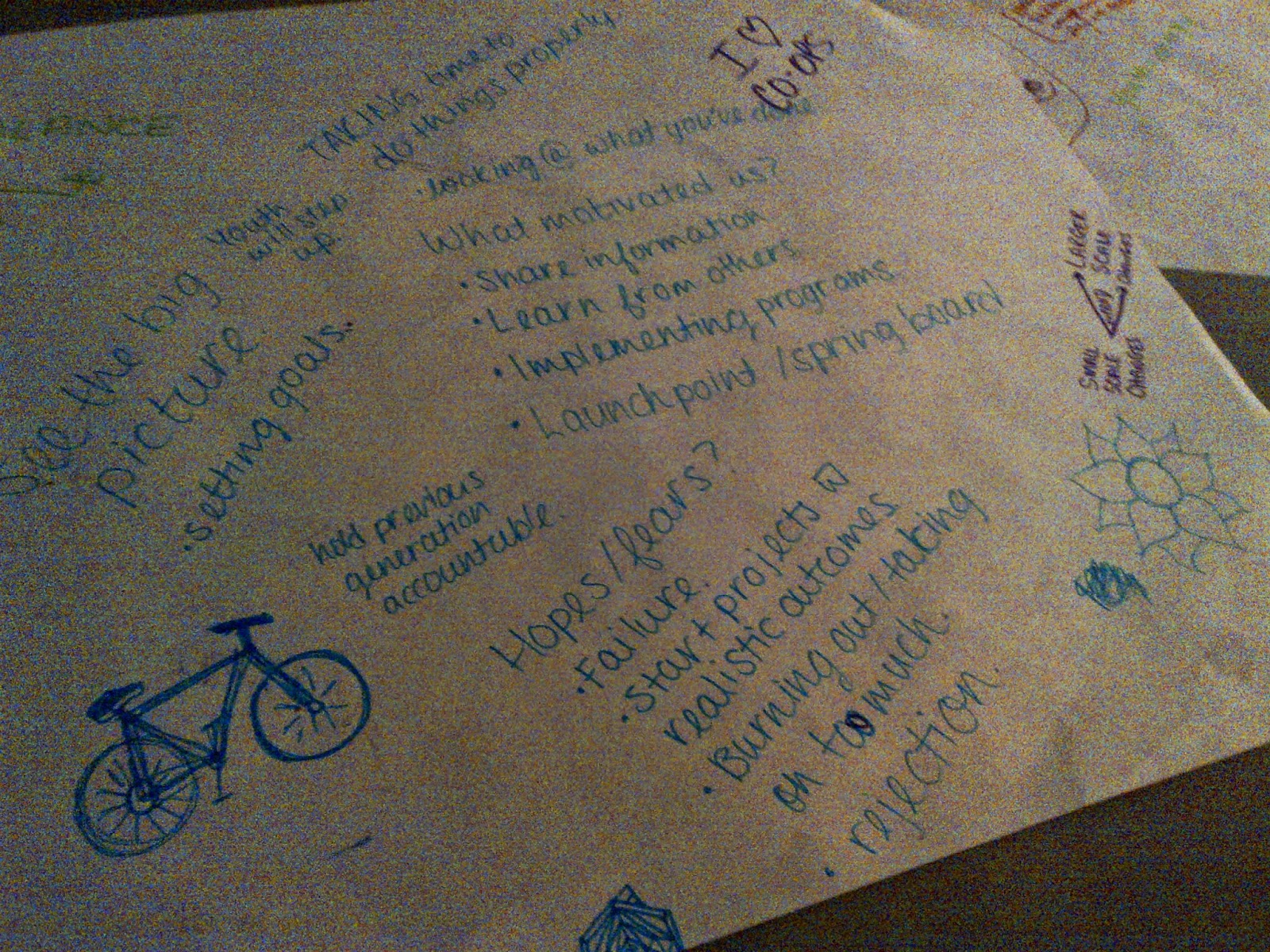
                                   One of many, many jottings and scribblings and ideas and
                                                collaborative discussions noted at Impact!

Even now, a couple weeks after returning from Guelph, I feel optimistic and recharged and amazed at the variety of ideas young people have for tackling sustainability! Alongside the boundless energy, optimism, and we-can-do-this attitude, there were hundreds of great ideas. Everything from a sticker campaign to try to get people to use only one sheet of paper towel in washrooms (which reminded me of these really powerful social media campaigns), to a national campaign on climate change education in schools by the symbolic turning off of lights for a day with the Lights Out Canada campaign to someone wanting to design a game-style app to help people keep track of and decrease their personal C02 use, to founding a cooperative, to starting a bike coop... and innumerable other brilliant ideas!!!

If you are a young person with a concern for the trajectory of the planet, apply to attend next year. It will change your life. I am so so so glad that I went. If you want a supportive environment, and be connected to funds that will help you carry out your sustainability ideas, go. (There is a fund you can apply for to help you undertake your projects, post-conference.)

For the rest of this post I'll talk about a few highlights from the conference, including the structure, but I won't be able to talk about all the good things; the post will get too long. I may return to this in the future again.

The conference was essentially a three day adventure of conversations and brain food.
We arrived Friday afternoon, and were shuttled to Guelph from the Toronto International Airport. We put our things away in our residence rooms on campus, then marched across the small campus to the hall where dinner and the opening panel was starting.

We heard from Elizabeth Thompson, the Executive Coordinator of Rio +20; Toby Heaps, the President of Corporate Knights Inc.; and David Miller, the CEO of the World Wildlife Fund. Each brought their own and wide-ranging perspectives on climate change, sustainability, and assessment of where we are now. From hearing about some very neat sounding ideas (like governments of the future having a Ministry of Tomorrow) and sharing nuggets of wisdom, like (I'm paraphrasing here), "For people who think the little things don't matter, just remind them of what it's like to be bitten by a mosquito." (This, particularly relevant for folks who don't think the small initiatives like petitions for social change make a difference.) And, as young people, we were encouraged to not let ourselves be ignored. Our voices count just as much as any CEO or voting citizen or business owner. We should not feel a need to apologize for our views and our concerns, and we should use the clarity of our visions to instigate social change, and ask for what we want in a better future.
Yes, a lot of it was a call to action, but it was also incredibly encouraging.

                                  We walked past the beautiful president's house every morning
                                               on our way to breakfast and the conference.

The next morning, up early. All 175 of us had been split into ten sustainability challenge groups; mine was Canadian Resource Development. For the first 3 hours of the morning we basically griped about what we disliked about the current energy systems in Canada. A lot of discussion about the tar sands and oil and gas production came up, a lot about pipelines, a little bit about coal, and then a number of comments about the systemic issues of how these energy systems are integrated into society, as well as the lack of support/progress with renewable energies.

The first few hours of the afternoon were spent imaging Canadian resource development 30 years from now. Where would we be? What would we have? How would society be organized around energy production then? All sorts of things came up. About have the comments were directly aimed at renewable energies that don't produce greenhouse gases (GHGs), and the other half were comments about social conditions, like having a functioning democracy, and bettering communication.

The last part of the activity was a two-parter: discussing which factors enabled and which factors disabled our current resource development from reaching that future state.
It was an awesome day, with a wide variety of comments. In my group we had students from engineering, and chemistry, philosophy and other social sciences—an awesome spread of views and perspectives that led to a really rich discussion. The name of this day-long activity: back-casting. You assess the current state, imagine a future (utopic) state, and think about how you can get there and what's preventing you from getting there.

The next day we had Commander Chris Hadfield come and speak to us. What an amazing speaker with a powerful message: collaboration can lead us to do great things, like putting an international space station (ISS) in the sky, and sending a man to the moon. He showed a number of images of the earth from the ISS, including one snapped of the great lakes and Guelph. You couldn't see that city from the image, but that was kind of the point. You couldn't see a lot of things from there: roads, houses, borders, security checks, etc. It reminded me a lot of Carl Sagan's "Pale Blue Dot" -- and the perspective that makes us realize we're all on Spaceship Earth together. It's us and this tiny little planet, hurtling through space at 25,000 km/hr, and so we better work together to make the best of our time here. His talk was really a call for taking personal responsibility seriously: if I don't choose to make change, then how can I ask someone else to?
Commander Hadfield teared up when we gave him a standing ovation. After 25+ years of being an astronaut, and much of it spent out of the country, he was really touched by our appreciation and expression of gratitude towards him.

                                    Commander Chris Hadfield receiving his t-shirt! :) Looks to
                                                                 be about the right size!

We had a World Cafe where people could bring forward project ideas and receive feedback from three different groups or students as we rotated through the hall; in the evening we also had an African drum session which was a great way to do something physical after all the brain work and thinking.

On the last day, we had wrap-up speech by Chad Park, the Executive Director of The Natural Step. The main two points he wanted to make were:
1. Believe. Be passionate, powerful, and know you are right.
2. Be empathetic. Listen. Know that you are wrong.
And he spent the talk unpacking what he meant by those two statements, including busting some myths about sustainability (such as it simply meaning to do 'less bad,' [it isn't, it's meant to be a movement of finding ways to do more good, and to help more people]) and encouraging us to call out people who try to get away with lazy sustainability.

Overall, one of the most important aspects of the conference was meeting a whole bunch of like-minded people who are so motivated to make change, that, echoing one of the rhetorical questions by one of the student leaders, I feel compelled to ask myself, What excuse do I have not to act?