Showing posts with label research. Show all posts

Thursday, 12 May 2016

Post 80: Research Ethics

Finally this post! This one is a bit of a long one, but ethics are important, so it's worth it. The week following the presentation on research data management plans, Dr. Natalie Ban also organized a discussion-based workshop on research ethics with Human Resources Ethics Coordinator Ms. Eugenie Lam. Since several of the students in the new cohort of graduate students this year were beginning or in the middle of their ethics applications, it seemed like a good time to check in with Ms. Lam to ask any questions.

I went because I really enjoy thinking about research, and had to submit my own ethics application for my thesis research. I also attended this presentation with a few specific questions around technology and ethics: how best to gather and store confidential data using the internet? Are there any best practices around what technologies/programs we can or should use? Or should not use?

A fairy hill of fawn lilies at Thetis Lake! 
For a little bit of background: researchers in Canada (and likely in different countries, according to those countries' regulations) are bound by federal law to comply with a set of research ethics and standards. In Canada, the Tri-Council (the Social Sciences and Humanities Research Council or SSHRC, the Natural Science and Engineer Research Council or NSERC, and Canadian Institutes of Health Research, or CIHR) sets out regulations that govern research across the country, and each higher education institution needs to ensure that its researchers comply with those regulations. The policy can be found right here, actually.  It's the same policy that Ms. Lam and the Human Research Ethics Board look at when assessing applications.

As graduate students, we typically need to start thinking about, and then following through on applying for our ethics applications towards the end of our second semesters, or when coursework finishes up. I remember spending about 40 hours—an entire week—working on my ethics application. The hard work paid off in my case, however: I didn't have any revisions to make when my application was assessed, which I understand is unusual. But I was very diligent, made sure to include ALL of my recruitment materials, appendixes, and fill out every question in the form.  UVic's ethics application can be found here. There's also an annotated version that helps you understand what information each section of the form is asking for. So useful!

You want to take a look at the application form early into the semester, not only because you get a sense for the kind of information you need to think about, but also because the form is so detailed, it may actually help you with the design of your study.

More lovely quince! 
One word to the wise: the UVic Research Ethics Board is fantastic! The staff there are extremely helpful, and I would encourage all graduate students to think of them as allies. They are not there to police you and shut down your research. Instead, they will help you figure out how to do what you want to do, even if there are some changes that need to be made.

You should complete your ethics application before you gather any data, but it's a good idea to make some initial contact with some of the folks in the community you want to study (speaking from a qualitative/interview-based research perspective), whether to suss out your initial research questions, or just get a sense of whether your project is possible/worthwhile/interesting. An observation from Ms. Lam at the session was that if you want to conduct research with First Nations communities, you likely need to either have pre-existing connections to the community you want to study, or you will need to rely heavily on pre-existing relationships that your supervisor has established, otherwise it will be very difficult to quickly build the trust, rapport, and relationships you typically need to recruit participants for your study. There is often an expectation that work with specific communities will also result in co-benefits for the participants or community as well, so keep that in mind, too.

Once your application is approved, it will be valid for one year. I highly recommend filling out the simple form to extend the duration of your application even if you are already writing your thesis and all your data collection is complete; you never know what might come up, and it's much easier to fill out a 2 page form, than to go through a whole new application if you didn't renew but need to go collect more data or something. Don't do that to yourself.

Afternoon Thetis Lake reflection. 
If you make any substantive changes to your study design, or the questions that you submit (for example, I submitted tentative interview questions, and updated my application with an amendment when they'd become finalized), you can easily modify your application. Just make sure you do it. You can always send an inquiry email first, describing your planned changes, to help determine if you need to submit an amendment or not.

What I also recommend is talking to other students in cohorts before yours, or other students of your supervisor's, or your supervisor's own work. If they have done similar research to yours, see if you can get a copy of their ethics application. Ms. Lam stated that the Ethics Board isn't able to keep A+ ethics applications from other researchers (I asked, because I do really well with models), but also recommended talking to your supervisor. Seeing how someone else thinks through similar questions can be incredibly helpful, and I know helped my own thinking along. If you want a copy of my ethics application, please drop me a line. I'd be happy to send it along, as long as it's only for your individual use.

Did I get my questions answered during this presentation? Well, yes and no. Turns out that there don't seem to be any best practices for how to gather data using the internet, Skype, or Google Hangouts... the best that you can do is be transparent with your participants so they know that you're using Skype or whatever the technology is, in order to talk to them.

Carrying through on due diligence for your research ethics ensures that you know how you're recruiting your participants, what you'll say, what you're asking from them, how you're going to obtain that data, what you will do with that data afterwards, and how you'll store if past your project.

So while it will take a good bit of work to think through the ethics application form, it can also be fun, and by the end of it, you'll know how to engage with your participants in an ethical, respectful, and safe way.

Wednesday, 30 March 2016

Post 78: Research Data Management Plans -- the Future of Data Curation

About a month ago, Wednesday, 24 February, found me sitting in the School of Environmental Studies' Dry Lab, a large meeting room in the David Turpin Building on campus. It was a sunny afternoon, and I was waiting with anticipation for my colleagues and the presenters from the on-campus library who were going to tell us about research data management plans.

The presentation seemed timely to me: for my own thesis project I had asked participants to allow me to keep their interview data (the recordings and the transcripts) for 10 years after they'd taken place (until 2024), and now that I'm nearing finishing my thesis, I'm starting to think about where to keep them once I'm finished. Some of my participants opted for full confidentiality to protect their identities, and I take that quite seriously. Once I'm out of academia, how do I best keep/store/move these protected data?

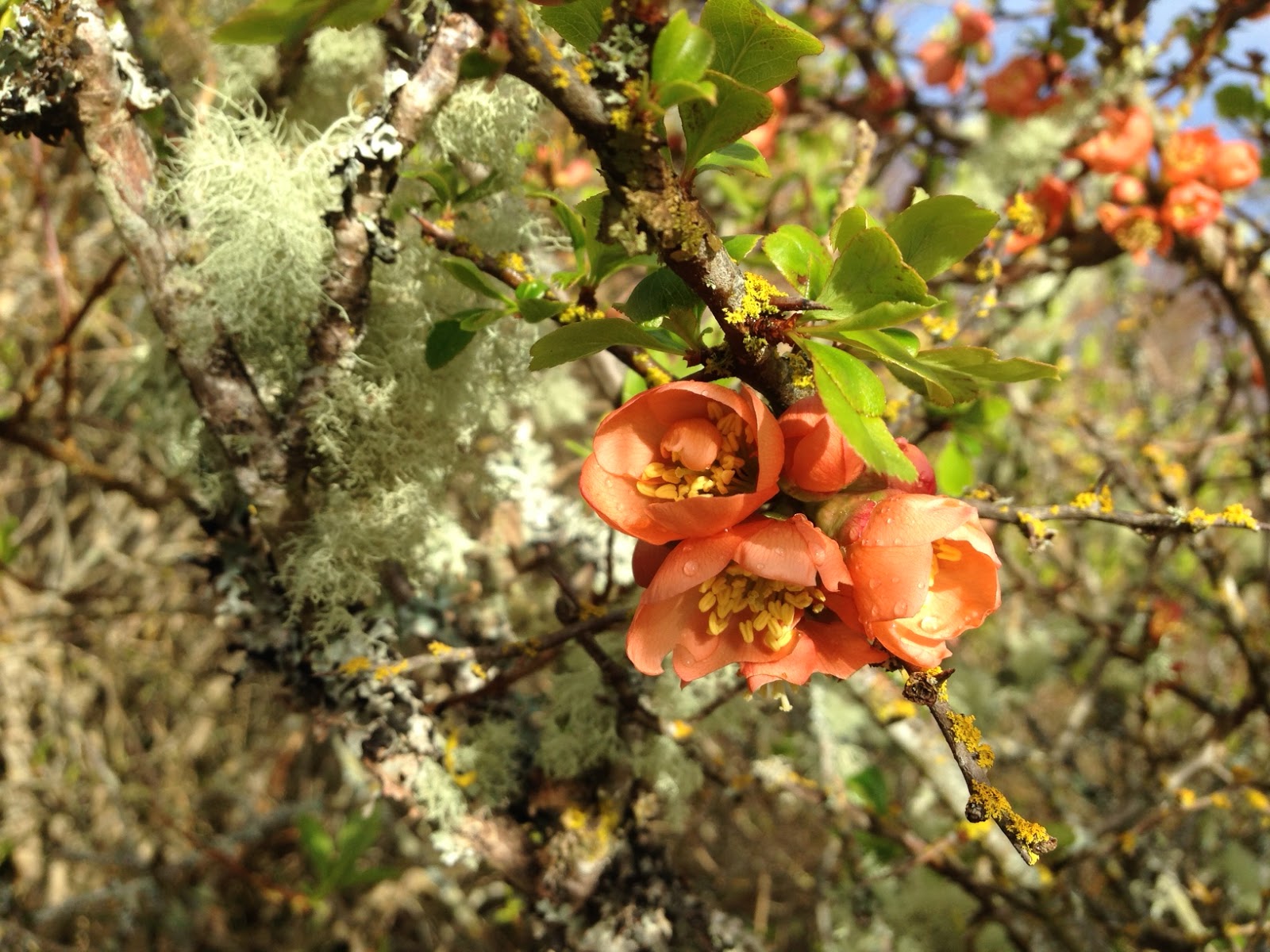
Chaenemeles species, or quince flowers! These ones are quite orange; others are more deep pink in colour. 
Research data management plans (RDMPs) are supposed to help with those questions, and, as I learned, a whole lot more. Our two wonderful presenters delivered a phenomenal talk on Research Data Management plans were Daniel Brendle-Moczuk, the subject librarian for the School of Environmental Studies (and other departments), from the Library References Services, and Kathleen Matthews, from Library Collections Management. Daniel delivered the presentation with input from Kathleen, and both answered questions at the end of the presentation. The presentation covered the what, why, why now, research data life cycle, and components of a data management plan, and I'll cover a brief overview of the presentation here. (In case I don't make sufficiently clear in the post, all of the material I share is from the presentation).

As Brendle-Moczuk and Matthews characterized, Canada is quite behind on its thinking about and thinking through RDMPs. This became quite apparent throughout the presentation, as Daniel's referred and source documents were all either America or out of the UK. For example, "Data Management for Researchers" is written by Krisin Briney, a US-based data management specialist, as are Mark Allen and Dalton Cervo, authors of the text "Mulit-Doman Master Data Management" and "Data Protection and the Cloud: Are the Risks too Great?"by UK author Paul Ticher.  Brendle-Moczuk also frequently cited documents and resources from the UK Data Service and DataONE, or Data Observation Network for Earth (US based).

Backyard Camellia flowers that have fallen. They're beautiful splashes of colour, but they don't last long!

All of this is to say that RDMPs are coming to Canada, and they're overdue. Research data management plans make you think through all aspects of your data: how to gather them, what kinds you want to gather (photos, audio, surveys, questionnaires, interviews, numerical data, geo-spatial data?), how you are going to name your files and organize them (a filename of "Sam's data" is probably only useful to Sam... unless detailed metadata^^^ exist to tell us how to use and interact with the data in the file), what the best formats for them are (remember floppy disks? Or will [proprietary software of your choice] be available in 10 years?), how you are going to treat confidential data and transport them, and how you are going to store and share them. Other questions are also important to consider, such as who has access to my data? And how is it protected if it needs to be?*** What is the researcher's responsibility when it comes to the lifetime of the data, and what are the ethics and legal considerations to take when working with data. The RDMPs make you think about all of these things, and it's very likely that your RDMP is going to need to accompany your grant applications in the future.

***Some of these questions you need to think about when you (if you) complete a Research Ethics Application, which I will cover in an upcoming post.

^^^metadata are the notes and data that tell you about a different set of data. For example, my thesis project is a qualitative research project that collected interviews as the primary data. I also had academic and grey literature that informed my research. The metadata would be a set of notes that are key to explaining my data: where the interviews are kept, how they are kept, which files they are located in, what different acronyms are, where my literature is kept, how that's organized, which program was used to analyze my data, etc. The metadata would be necessary for someone else to understand my data, and how it all fits for my project. Are there organizational responsibilities when it comes to metadata? You bet! Be neat. Be organized. And be consistent with your file names and organizing. And if you ever have the thought "I'll remember this later..." WRITE IT DOWN! I guarantee you, you won't remember.

A bouquet of neighbourhood daffodils I picked for my landlady Kathryn, before her trip!
Currently, there are strong indications that RDMPs are going to become required for researchers in Canada in the future. The Tri-Council of Canada issued a draft statement of principles on digital data management in July of last year, that outlined researchers' responsibilities when it comes to data management. These responsibilities include the collection, formatting, preservation, and sharing of their data through out the lifetime of a project and beyond. There's no telling when that statement will no longer be a draft but become a requirement for researchers, but it applies to the hard sciences and social sciences a lot, so I think it's wise to begin thinking through research data management now.

For a very cute video that added some humour to the presentation, check out "Data Sharing and Management Snafu in 3 Short Acts" (I'm so glad that Daniel found this!).

Gorgeous Lower Thetis Lake reflection. Where does the water start and stop?
A quick and flashy reminder: always make backups of your data. Always. Follow the 3-2-1 Rule:
3 copies, in 2 different media, with 1 backup located offsite.

And one last note: a practice becoming more frequent is for researchers or organizations being asked to prove their research impact, which Brendle-Mozcuk and Matthews recommended as being most easily done with a DOI, or a digital object identifier. It is a persistent link that follows the data, and that can be used when citing data that's used. In Canada, the National Science Library provides a service through DataCite Canada that is: "A data registration service that provides Canadian data centres and libraries with a mechanism for registering research data and assigning digital object identifiers (DOIs) to them. These identifiers allow research data to be findable, citable and accessible for replication and further use." So make sure to check this out if this may be applicable to you. 

Good luck, fellow jedi researchers! I'm sure that you will plan and manage your data well after this post, or at least avoid making some very painful errors with your data. Hugs! 

Monday, 8 February 2016

Post 72: Northwest Climate Conference 2015 -- An Overdue Review

This past November I attended the Northwest Climate Conference 2015 (formerly the Pacific Northwest Climate Conference), held in Coeur d'Alene, Idaho, a very cute little town that I hadn't visited since childhood on a trip with my grandparents. I attended in my capacity as a research assistant at Royal Roads under Dr. Johanna Wolf, a contract I've had for the past year. Excitingly, she was invited to speak as one of the closing keynote panelists, and I think her talk went really well! A significant number of the talks from the conference are available with this link here.

Beautiful clouds on the flight down.
Overall, the conference was great. I heard Bill Geer, the recently retired Climate Change Initiative Manager for the Theodore Roosevelt Conservation Partnership, deliver a talk on his travels through the Pacific Northwest to engage with hunting groups and associations—folks who can be a bit more politically conservative—to look at the observations they had already made about population shifts and range changes for many of the species they regularly engage with during the hunting season. This led to making some connections about the impacts of climate change where they hadn't, perhaps, before been made, and this is fantastic!

Overall, a nice component of the project was that it did connect practitioners and scientists, and I was really happy to see a group of high school students in attendance from the local school because of a really intrepid teacher. In retrospect, I have also been amazed by the seeming united front that some of the state governments and the federal government presence showed at the conference. We have nothing like that here in Canada, and the variability of the federal, provincial, and municipal governments' approaches and progress on adaptation is apparent very quickly. In the research project that we took to the conference, for example, I recall one local decision-maker highlight that at a recent meeting (Fall 2015), one of the mayors of a municipality with a significant amount of coastline had leaned in to ask this person if they had been thinking about sea level rise for their municipality, implying that he never had. This decision-maker was shocked that this municipality's main man hadn't thought about this issue before! 


Loved this little sand spit in I saw somewhere in the Puget Sound area as we got
near Seattle! It looks like a dinosaur to me!
While I skipped the Tools Cafe and opted for a short break from the conference instead, I did attend the Adaptation Speed-Dating event that took place at lunch time on the second day, offering a recommendation for how like-minded groups can communicate (not a new email or list-serve or newsletter, please, but tap into existing communications networks, and make connections among them). The crammed full schedule of the conference was certainly something to note: it was go go go, and after two and a half days I was exhausted! Definitely way to go on cramming a lot of stuff into a few days, because my brain was certainly filled to the brim with the new people I'd met, and the research I was hearing about, but sometimes I wonder if there isn't a better way to take in information at a conference.... 

In many ways, the logistics were fantastic: the size of the conference (no more than ~320 participants a day) made it fairly easy to find colleagues and speakers that really made me sit up straight and pay attention during their talks. And/or find people I recognized from the conference when I attended two or three years ago. On the note of colleagues, however: myself, Dr. Wolf, and Stephen Sobie, the Regional Climate Impacts Analyst at the Pacific Climate Impacts Consortium (UVic) were the only Canadians in attendance! I spoke with a few of the organizers about this, and realized that there was a very big opportunity to extend invitations to a much wider group of my Canadian peers and colleagues who would be interested in attending, and an invitation to help do so for the next conference. Take note: those of you interested in climate change, mitigation, and adaptation issues: they don't stop at the 49th Parallel, and look for the 2016 Northwest Climate Conference held in either Seattle, Washington.
I took this as a friendly reminder that yes, my country (The North Pole) is not that far away. :)
There were certainly a number of themes that resonated from when I attended the conference 3 years ago. This year, as in the past, there was much discussion about precipitation and responses to climate. The running hypothesis and projections seem to point to there not being significant differences in precipitation amounts in a warmed climate for the Pacific Northwest, though the form of the precipitation will likely change, and this will have significant downstream impacts. On a few different occasions: "Rain is good, but snow is better!" was stated, and it began to sound a bit like a conference slogan.

Unlike rain, snow extends the seasonality of moisture because of the length of time that snow can last into the year from when it first falls. Rain falls and needs to go somewhere, or be used at once. It has an immediate effect on local hydrologic cycles, while snow has a more prolonged effect. Snow takes longer to melt, and lasts into the spring and early summer, which has directly relationships to timing of peak and low stream flows, and the availability of water for cities, animals, and ecosystems. Snow is a central component of the water cycles in the northwestern states (and British Columbia, too!), and its worrisome that we are seeing snowpack decline, as Phil Mote and colleagues first presented in their 2005 paper "Declining mountain snowpack in western North America."

My first real frost of the year! It came decorating these leaves with beautiful sparkles!
Probably one of the best talks I went to wasn't actually a talk: it was a hands on, adaptation mini-workshop that was hosted by the Climate Impacts Group (CIG), which led us through four key stages of an adaptation planning process for projects that we had on the go. It is the same one that they use with clients to think through various aspects of adaptation. It was very very good.

We were encouraged to tweet (#nwclimate2015) about the conference and while we were there—which was a fantastic idea, and made me think of the positive attention that Canadian researcher Catherine Scott received around Halloween this past year, live-tweeting with grace and humour about the spider sex she was gathering data of in her lab—but to avoid major roaming fees on my cell, I'd left it at home. That made me brainstorm about how to make something like that more accessible for international attendees like me. Maybe guidelines ahead of time about tweeting abroad (using the wireless network) or having a cell-phone share or something like that from a general account for the conference? (My sincere apologies if I am revealing my lack of technological understanding here.) :) But I really appreciated the encouragement to extend the impact of the conference and interest in it through social media while I was there.

Mudgy the Moose; Millie the Mouse is, unfortunately, not easy to see in the dark!
Aside from the intellectual party that the conference was (I really enjoy learning about what research is currently being done and really on the edge of pushing our boundaries of knowledge), it was also a great way to explore a different city in the Pacific Northwest. I went for a lovely two midnight walks along the World's Longest Boardwalk, which extended as a floating boardwalk around their main boat dock area, and met the a few of the local Mudgy the Moose (shown above) and Millie the Mouse statues in town, which mark their walking trails. Overall, it was a great trip, and I hope I can attend next year's conference again.