This morning as I packed my bags for school, I was excited to head to campus to meet some of my colleagues and bring them a little surprise. Yesterday while grocery shopping I bought a big packet of Twizzlers (remembering that Mary loves them), and for those who might not be so into gummy strawberry-flavoured sticks, I got a couple Turtles and a packet of Smarties. I had a jolt of joy thinking about the delight I hope the gift will bring.
The summer is that time of year when a lot of graduate students head to to collect their data, and this summer is no exception for the School of Environmental Studies.
Throw-back to my time in the mountains: Hard at work writing field notes!
(Photo credit: Mary Sanseverino)
For some, this process started already a few months ago, and the halls of the buildings become doubly quiet: first from the undergraduate students that no longer visit professors, sessional instructors and teaching assistants during their office hours as classes find their end in April, and then when the grad students take to the mountains and oceans and communities in which they conduct their studies.
Last year I packed my rental vehicle and drove from the Kootenays to Prince George and back, and made another trip to Edmonton to visit the lovely folks that I was interviewing about the mountain pine beetle. I had my recording device, spare batteries, interview questions, my usb cards, a notebook, the casual professional clothing I was going to wear, my driver's license, money, everything I thought I needed for that trip. And, here's where maybe my best advice for going into the field: do your planning and prep for your field work as soon in advance as possible. You don't want to be scrambling in the last few hours before a big (or even small, but important) trip, sometimes to places where you'll have limited access to resources. For last year, my recording device, batteries, and interview questions were super key to the success of my trip. This year, being a supporter (a small one) for the MLP crew, I thought they needed some treats in the car on their drive; the rest was up to them. :) So, with that in mind, the other tips below are suggestions from when I spent time in the mountainous field with MLP, and the ones above, from my social science, qualitative interviews field work last year. Your approach is probably your best tool to being prepared. :)
Two great examples of being prepped for the weather: sandals for the
black sand beach just outside of Hana, Maui.
...and sunglasses and a windbreaker to brave the chilly
winds at 10,000 feet on top of Haleakala, Maui!
This year marks the two year anniversary since my field season with the Mountain Legacy Project (MLP), who were gathering their gear and packing the truck for this year's two-team outing!
My self-set task this year was to be supportive and to provide some tips; what's best to bring and pack when you're going to be spending 8 weeks in the mountains?
Some of my top suggestions for this work (definitely reminiscent of this blog post for MLP):
-earplugs (for entering and exiting the helicopters, when it's is so, so loud!! And, you never know when some bird will wake you at 5AM and you can't quite get back to sleep, or when a bunkmate might snore....)
-longjohns (it's several degrees cooler at elevation)
-fleece sweaters and a windbreaker and layers (frequently breezy, which affects core temperature due to abovementioned point)
-make sure to get enough sleep, eat enough food, drink and pack enough water
-take lots of photos and keep a journal to record all those special moments
-a hat, bug spray, and polarized sunglasses
-a couple of your own bandaids
-NO cotton; cotton gets cold when wet, and can contribute to hypothermia in the right conditions. Unless you're somewhere super hot and humid, you're better off with breathable, layered clothes that aren't cotton, in the mountains
Sorting out account log-in information for the blog has brought me into nostalgia mode: how fun that summer was, spending time with Jenna and Mary and the big big mountainous landscapes of BC and Alberta. Huge pockets of rain cells that you could see and avoid in the helicopters. The big shadow splotches of clouds on the forests and mountain sides, that bring texture and richness to a landscape's colour. The quiet. The buzzing insects, pollinating and zipping around at 8000+ feet, causing me to wonder how on earth they survive up there. The mosquitos and their ferocity (and the difference with being on the wind- or lee-ward side of a slope). The birds-eye view from the helicopter, and the bits of fun and banter with the pilots.
So much fun! Wishing them all the very best and a great field season for 2014!
Monday, 30 June 2014
Tuesday, 10 June 2014
Post 19: Impact! 2014 and Student Leadership in Sustainability
When was the last time that you stood in a room full of 175 people, knowing you could turn to any of them, and strike up an interesting conversation? For me, that was 3 weeks ago at the Impact! 2014 Youth Leadership in Sustainability Conference. WOW --- what a blast!
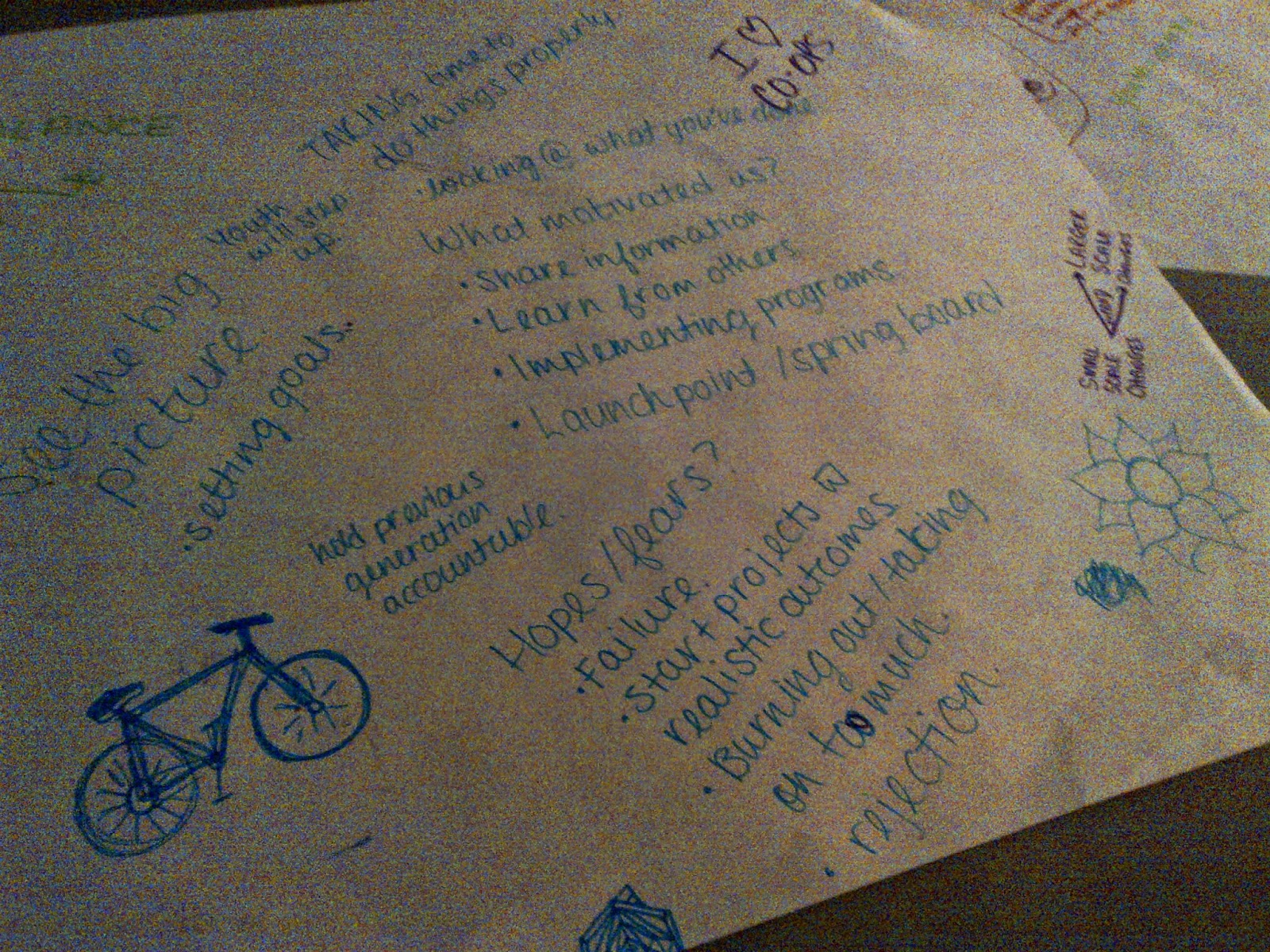
One of many, many jottings and scribblings and ideas and
collaborative discussions noted at Impact!
Even now, a couple weeks after returning from Guelph, I feel optimistic and recharged and amazed at the variety of ideas young people have for tackling sustainability! Alongside the boundless energy, optimism, and we-can-do-this attitude, there were hundreds of great ideas. Everything from a sticker campaign to try to get people to use only one sheet of paper towel in washrooms (which reminded me of these really powerful social media campaigns), to a national campaign on climate change education in schools by the symbolic turning off of lights for a day with the Lights Out Canada campaign to someone wanting to design a game-style app to help people keep track of and decrease their personal C02 use, to founding a cooperative, to starting a bike coop... and innumerable other brilliant ideas!!!
If you are a young person with a concern for the trajectory of the planet, apply to attend next year. It will change your life. I am so so so glad that I went. If you want a supportive environment, and be connected to funds that will help you carry out your sustainability ideas, go. (There is a fund you can apply for to help you undertake your projects, post-conference.)
For the rest of this post I'll talk about a few highlights from the conference, including the structure, but I won't be able to talk about all the good things; the post will get too long. I may return to this in the future again.
The conference was essentially a three day adventure of conversations and brain food.
We arrived Friday afternoon, and were shuttled to Guelph from the Toronto International Airport. We put our things away in our residence rooms on campus, then marched across the small campus to the hall where dinner and the opening panel was starting.
We heard from Elizabeth Thompson, the Executive Coordinator of Rio +20; Toby Heaps, the President of Corporate Knights Inc.; and David Miller, the CEO of the World Wildlife Fund. Each brought their own and wide-ranging perspectives on climate change, sustainability, and assessment of where we are now. From hearing about some very neat sounding ideas (like governments of the future having a Ministry of Tomorrow) and sharing nuggets of wisdom, like (I'm paraphrasing here), "For people who think the little things don't matter, just remind them of what it's like to be bitten by a mosquito." (This, particularly relevant for folks who don't think the small initiatives like petitions for social change make a difference.) And, as young people, we were encouraged to not let ourselves be ignored. Our voices count just as much as any CEO or voting citizen or business owner. We should not feel a need to apologize for our views and our concerns, and we should use the clarity of our visions to instigate social change, and ask for what we want in a better future.
Yes, a lot of it was a call to action, but it was also incredibly encouraging.
We walked past the beautiful president's house every morning
on our way to breakfast and the conference.
The next morning, up early. All 175 of us had been split into ten sustainability challenge groups; mine was Canadian Resource Development. For the first 3 hours of the morning we basically griped about what we disliked about the current energy systems in Canada. A lot of discussion about the tar sands and oil and gas production came up, a lot about pipelines, a little bit about coal, and then a number of comments about the systemic issues of how these energy systems are integrated into society, as well as the lack of support/progress with renewable energies.
The first few hours of the afternoon were spent imaging Canadian resource development 30 years from now. Where would we be? What would we have? How would society be organized around energy production then? All sorts of things came up. About have the comments were directly aimed at renewable energies that don't produce greenhouse gases (GHGs), and the other half were comments about social conditions, like having a functioning democracy, and bettering communication.
The last part of the activity was a two-parter: discussing which factors enabled and which factors disabled our current resource development from reaching that future state.
It was an awesome day, with a wide variety of comments. In my group we had students from engineering, and chemistry, philosophy and other social sciences—an awesome spread of views and perspectives that led to a really rich discussion. The name of this day-long activity: back-casting. You assess the current state, imagine a future (utopic) state, and think about how you can get there and what's preventing you from getting there.
The next day we had Commander Chris Hadfield come and speak to us. What an amazing speaker with a powerful message: collaboration can lead us to do great things, like putting an international space station (ISS) in the sky, and sending a man to the moon. He showed a number of images of the earth from the ISS, including one snapped of the great lakes and Guelph. You couldn't see that city from the image, but that was kind of the point. You couldn't see a lot of things from there: roads, houses, borders, security checks, etc. It reminded me a lot of Carl Sagan's "Pale Blue Dot" -- and the perspective that makes us realize we're all on Spaceship Earth together. It's us and this tiny little planet, hurtling through space at 25,000 km/hr, and so we better work together to make the best of our time here. His talk was really a call for taking personal responsibility seriously: if I don't choose to make change, then how can I ask someone else to?
Commander Hadfield teared up when we gave him a standing ovation. After 25+ years of being an astronaut, and much of it spent out of the country, he was really touched by our appreciation and expression of gratitude towards him.
Commander Chris Hadfield receiving his t-shirt! :) Looks to
be about the right size!
We had a World Cafe where people could bring forward project ideas and receive feedback from three different groups or students as we rotated through the hall; in the evening we also had an African drum session which was a great way to do something physical after all the brain work and thinking.
On the last day, we had wrap-up speech by Chad Park, the Executive Director of The Natural Step. The main two points he wanted to make were:
1. Believe. Be passionate, powerful, and know you are right.
2. Be empathetic. Listen. Know that you are wrong.
And he spent the talk unpacking what he meant by those two statements, including busting some myths about sustainability (such as it simply meaning to do 'less bad,' [it isn't, it's meant to be a movement of finding ways to do more good, and to help more people]) and encouraging us to call out people who try to get away with lazy sustainability.
Overall, one of the most important aspects of the conference was meeting a whole bunch of like-minded people who are so motivated to make change, that, echoing one of the rhetorical questions by one of the student leaders, I feel compelled to ask myself, What excuse do I have not to act?
One of many, many jottings and scribblings and ideas and
collaborative discussions noted at Impact!
Even now, a couple weeks after returning from Guelph, I feel optimistic and recharged and amazed at the variety of ideas young people have for tackling sustainability! Alongside the boundless energy, optimism, and we-can-do-this attitude, there were hundreds of great ideas. Everything from a sticker campaign to try to get people to use only one sheet of paper towel in washrooms (which reminded me of these really powerful social media campaigns), to a national campaign on climate change education in schools by the symbolic turning off of lights for a day with the Lights Out Canada campaign to someone wanting to design a game-style app to help people keep track of and decrease their personal C02 use, to founding a cooperative, to starting a bike coop... and innumerable other brilliant ideas!!!
If you are a young person with a concern for the trajectory of the planet, apply to attend next year. It will change your life. I am so so so glad that I went. If you want a supportive environment, and be connected to funds that will help you carry out your sustainability ideas, go. (There is a fund you can apply for to help you undertake your projects, post-conference.)
For the rest of this post I'll talk about a few highlights from the conference, including the structure, but I won't be able to talk about all the good things; the post will get too long. I may return to this in the future again.
The conference was essentially a three day adventure of conversations and brain food.
We arrived Friday afternoon, and were shuttled to Guelph from the Toronto International Airport. We put our things away in our residence rooms on campus, then marched across the small campus to the hall where dinner and the opening panel was starting.
We heard from Elizabeth Thompson, the Executive Coordinator of Rio +20; Toby Heaps, the President of Corporate Knights Inc.; and David Miller, the CEO of the World Wildlife Fund. Each brought their own and wide-ranging perspectives on climate change, sustainability, and assessment of where we are now. From hearing about some very neat sounding ideas (like governments of the future having a Ministry of Tomorrow) and sharing nuggets of wisdom, like (I'm paraphrasing here), "For people who think the little things don't matter, just remind them of what it's like to be bitten by a mosquito." (This, particularly relevant for folks who don't think the small initiatives like petitions for social change make a difference.) And, as young people, we were encouraged to not let ourselves be ignored. Our voices count just as much as any CEO or voting citizen or business owner. We should not feel a need to apologize for our views and our concerns, and we should use the clarity of our visions to instigate social change, and ask for what we want in a better future.
Yes, a lot of it was a call to action, but it was also incredibly encouraging.
We walked past the beautiful president's house every morning
on our way to breakfast and the conference.
The next morning, up early. All 175 of us had been split into ten sustainability challenge groups; mine was Canadian Resource Development. For the first 3 hours of the morning we basically griped about what we disliked about the current energy systems in Canada. A lot of discussion about the tar sands and oil and gas production came up, a lot about pipelines, a little bit about coal, and then a number of comments about the systemic issues of how these energy systems are integrated into society, as well as the lack of support/progress with renewable energies.
The first few hours of the afternoon were spent imaging Canadian resource development 30 years from now. Where would we be? What would we have? How would society be organized around energy production then? All sorts of things came up. About have the comments were directly aimed at renewable energies that don't produce greenhouse gases (GHGs), and the other half were comments about social conditions, like having a functioning democracy, and bettering communication.
The last part of the activity was a two-parter: discussing which factors enabled and which factors disabled our current resource development from reaching that future state.
It was an awesome day, with a wide variety of comments. In my group we had students from engineering, and chemistry, philosophy and other social sciences—an awesome spread of views and perspectives that led to a really rich discussion. The name of this day-long activity: back-casting. You assess the current state, imagine a future (utopic) state, and think about how you can get there and what's preventing you from getting there.
The next day we had Commander Chris Hadfield come and speak to us. What an amazing speaker with a powerful message: collaboration can lead us to do great things, like putting an international space station (ISS) in the sky, and sending a man to the moon. He showed a number of images of the earth from the ISS, including one snapped of the great lakes and Guelph. You couldn't see that city from the image, but that was kind of the point. You couldn't see a lot of things from there: roads, houses, borders, security checks, etc. It reminded me a lot of Carl Sagan's "Pale Blue Dot" -- and the perspective that makes us realize we're all on Spaceship Earth together. It's us and this tiny little planet, hurtling through space at 25,000 km/hr, and so we better work together to make the best of our time here. His talk was really a call for taking personal responsibility seriously: if I don't choose to make change, then how can I ask someone else to?
Commander Hadfield teared up when we gave him a standing ovation. After 25+ years of being an astronaut, and much of it spent out of the country, he was really touched by our appreciation and expression of gratitude towards him.
Commander Chris Hadfield receiving his t-shirt! :) Looks to
be about the right size!
We had a World Cafe where people could bring forward project ideas and receive feedback from three different groups or students as we rotated through the hall; in the evening we also had an African drum session which was a great way to do something physical after all the brain work and thinking.
On the last day, we had wrap-up speech by Chad Park, the Executive Director of The Natural Step. The main two points he wanted to make were:
1. Believe. Be passionate, powerful, and know you are right.
2. Be empathetic. Listen. Know that you are wrong.
And he spent the talk unpacking what he meant by those two statements, including busting some myths about sustainability (such as it simply meaning to do 'less bad,' [it isn't, it's meant to be a movement of finding ways to do more good, and to help more people]) and encouraging us to call out people who try to get away with lazy sustainability.
Overall, one of the most important aspects of the conference was meeting a whole bunch of like-minded people who are so motivated to make change, that, echoing one of the rhetorical questions by one of the student leaders, I feel compelled to ask myself, What excuse do I have not to act?
Sunday, 11 May 2014
Post 18: What is Methodology?
I've been stewing over this question for the last 12 months or so, and more seriously the last 8, because I've been trying to figure out, What is methodology for my project?
I had a meeting with my committee in September, where I outlined a few books I would read in order to help me answer this question, and among them: Hugh Gusterson's "Nuclear Rites: A Weapons Laboratory at the end of the Cold War"; Sharon Traweek's "Beamtimes and Lifetimes: The World of High Energy Physicists"; Donna Haraway's "Primate Visions: Gender, Race, and Nature in the World of Modern Science", and a couple other texts that I'm still working my way through, including "States of Knowledge: The co-production of science and social order," edited by Sheila Jasanoff, and "Actor Network Theory and after" by John Law and John Hassard.
Trying to understand and track down what methodology is, is not very easy. I've spoken with a number of different people, to find that I'm easily discouraged by the somewhat contradictory things I've heard: there are so many different ideas of what methodology is! (And from what I understand, it's very much the experience of a master's trying to figure out, What is methodology.). So, despair not if you're like me, and struggling to sort this all out.
One friend's advice? It doesn't make sense to stew about methodology in the abstract. It will make a lot more sense by the time that you start to sit down and ready yourself for writing, because it'll help direct you for what you need to say. And I think that now that I feel like I'm on the brink of starting to get everything together, that makes a lot of sense. (Now would be a great time for a research methods and methodology class!)
Here, Google's definition:
"Methodology is the systematic, theoretical analysis of the methods applied to a field of study, or the theoretical analysis of the body of methods and principles associated with a branch of knowledge. It, typically, encompasses concepts such as paradigm, theoretical model, phases and quantitative or qualitative techniques.[1]
A methodology does not set out to provide solutions but offers the theoretical underpinning for understanding which method, set of methods or so called “best practices” can be applied to a specific case.
A pause for some bright swamp lantern (Symplocarpus foetidus).
It has been defined also as follows:
Which kinds of gets us somewhere, but I certainly struggled to make heads or tails of this definition months ago.
Some people said really confusing things like 'methodology is interchangeable with methods, but that doesn't make sense to me. The methods that I'm using are semi-structured interviews (my primary method), along with selective document analysis, and journaling. So, there's something missing here that isn't captured by just saying methodology is the set of methods that I'm using.
What I've arrived to more recently, is deciding that methodology means 'approach', and being able to justify why you made the decisions you made, including which methods to go with (empirical, qualitative, quantitative, etc), and why that suite of methods together, in order to best answer the research questions you posed.
So, where does that leave me? I've been trying to articulate my approach to myself for some time now. I interviewed scientists directly because the kinds of perspectives and ideas I wanted to know are not apparent in the published work that's publicly available. I wanted to focus on the intersection of the mountain pine beetle and scientists because I wanted to be sensitive to other non-human beings and their influence on the practice and perspectives of humans -- does the scale of the ecological/environmental change associated with the beetle challenge or change any of the key perspectives of scientists, and what does that look like? In so doing, I needed to read widely and deeply about the mountain pine beetle, and hone in on a group or network of scientists that I thought would be manageable to interview. I decided to focus on what I saw as a coming together of 5 research hubs, some closely linked, others not so, and I think it went reasonably well. Of course there are other people that I would have loved to interview, but as it was, there were only so many positive responses that I received, and could proceed with.
The other major focus of my thesis project has been the concept of novel ecosystems, and I speculate that the mountain pine beetle moving into the boreal forest (an ecosystem it's never historically been in, from what scientists can see), is a hybrid ecosystem with novel characteristics (following a classification system outlined by recent work done for the concept). I'm still trying to grapple with the dimensions and differences with the epidemic and endemic mountain pine beetle population patterns, and what that means for the idea of the novel ecosystem.
Now, I'm also preoccupied with describing the key relationships I saw forming and developing because of research that ensued in the context of climate change and the the climate-exacerbated mountain pine beetle, and what that tells us about scientists' capacities for change and adaptation, and where that is applicable elsewhere! There were a number of comments about the 'novel' habitat of the mountain pine beetle; my analysis will need to make sense of exactly how that relates to my ideas of the novel ecosystems concept.
My methodological approach will help me to explain why I focused on the information out there as I did, why I then went on to analyze my interviews and look for certain themes and ideas arising (as well as others that emerged from the interviews), and to reconcile that with the shaping ideas that I have forming from the whole process of undertaking such an empirical, qualitative study.
So, I feel like while I have sort of been able to describe for myself what my idea of methodology is, sorting that out will need a little bit more care in the coming weeks as I wrap up analyzing my interviews and laying out my thesis and writing.
I was reading somewhere the other day again in Laurie Waye's Thesis Handbook (apologies, I was quickly looking into the text, and don't have it with me currently), who mentioned that there will undoubtedly be a lot more research that I've done that won't make it into the thesis. There are also countless methodologies and methods that one can use -- different lenses, if you'll permit the analogy a la Haraway, that can be used to undertake projects and interpret data, so, it really comes down to committing to one and running with it. Students who struggle to complete their theses are likely those who dig too broadly, instead of focusing and digging in deep, and in part, that really resonates with me.
So, here's to sorting out just a little bit more, exactly what my lens and my approach is in the coming little while!
I had a meeting with my committee in September, where I outlined a few books I would read in order to help me answer this question, and among them: Hugh Gusterson's "Nuclear Rites: A Weapons Laboratory at the end of the Cold War"; Sharon Traweek's "Beamtimes and Lifetimes: The World of High Energy Physicists"; Donna Haraway's "Primate Visions: Gender, Race, and Nature in the World of Modern Science", and a couple other texts that I'm still working my way through, including "States of Knowledge: The co-production of science and social order," edited by Sheila Jasanoff, and "Actor Network Theory and after" by John Law and John Hassard.
Trying to understand and track down what methodology is, is not very easy. I've spoken with a number of different people, to find that I'm easily discouraged by the somewhat contradictory things I've heard: there are so many different ideas of what methodology is! (And from what I understand, it's very much the experience of a master's trying to figure out, What is methodology.). So, despair not if you're like me, and struggling to sort this all out.
One friend's advice? It doesn't make sense to stew about methodology in the abstract. It will make a lot more sense by the time that you start to sit down and ready yourself for writing, because it'll help direct you for what you need to say. And I think that now that I feel like I'm on the brink of starting to get everything together, that makes a lot of sense. (Now would be a great time for a research methods and methodology class!)
Here, Google's definition:
"Methodology is the systematic, theoretical analysis of the methods applied to a field of study, or the theoretical analysis of the body of methods and principles associated with a branch of knowledge. It, typically, encompasses concepts such as paradigm, theoretical model, phases and quantitative or qualitative techniques.[1]
A methodology does not set out to provide solutions but offers the theoretical underpinning for understanding which method, set of methods or so called “best practices” can be applied to a specific case.
A pause for some bright swamp lantern (Symplocarpus foetidus).
It has been defined also as follows:
- "the analysis of the principles of methods, rules, and postulates employed by a discipline";[2]
- "the systematic study of methods that are, can be, or have been applied within a discipline";[2]
- "the study or description of methods".[3]"
Which kinds of gets us somewhere, but I certainly struggled to make heads or tails of this definition months ago.
Some people said really confusing things like 'methodology is interchangeable with methods, but that doesn't make sense to me. The methods that I'm using are semi-structured interviews (my primary method), along with selective document analysis, and journaling. So, there's something missing here that isn't captured by just saying methodology is the set of methods that I'm using.
What I've arrived to more recently, is deciding that methodology means 'approach', and being able to justify why you made the decisions you made, including which methods to go with (empirical, qualitative, quantitative, etc), and why that suite of methods together, in order to best answer the research questions you posed.
So, where does that leave me? I've been trying to articulate my approach to myself for some time now. I interviewed scientists directly because the kinds of perspectives and ideas I wanted to know are not apparent in the published work that's publicly available. I wanted to focus on the intersection of the mountain pine beetle and scientists because I wanted to be sensitive to other non-human beings and their influence on the practice and perspectives of humans -- does the scale of the ecological/environmental change associated with the beetle challenge or change any of the key perspectives of scientists, and what does that look like? In so doing, I needed to read widely and deeply about the mountain pine beetle, and hone in on a group or network of scientists that I thought would be manageable to interview. I decided to focus on what I saw as a coming together of 5 research hubs, some closely linked, others not so, and I think it went reasonably well. Of course there are other people that I would have loved to interview, but as it was, there were only so many positive responses that I received, and could proceed with.
The other major focus of my thesis project has been the concept of novel ecosystems, and I speculate that the mountain pine beetle moving into the boreal forest (an ecosystem it's never historically been in, from what scientists can see), is a hybrid ecosystem with novel characteristics (following a classification system outlined by recent work done for the concept). I'm still trying to grapple with the dimensions and differences with the epidemic and endemic mountain pine beetle population patterns, and what that means for the idea of the novel ecosystem.
Now, I'm also preoccupied with describing the key relationships I saw forming and developing because of research that ensued in the context of climate change and the the climate-exacerbated mountain pine beetle, and what that tells us about scientists' capacities for change and adaptation, and where that is applicable elsewhere! There were a number of comments about the 'novel' habitat of the mountain pine beetle; my analysis will need to make sense of exactly how that relates to my ideas of the novel ecosystems concept.
My methodological approach will help me to explain why I focused on the information out there as I did, why I then went on to analyze my interviews and look for certain themes and ideas arising (as well as others that emerged from the interviews), and to reconcile that with the shaping ideas that I have forming from the whole process of undertaking such an empirical, qualitative study.
So, I feel like while I have sort of been able to describe for myself what my idea of methodology is, sorting that out will need a little bit more care in the coming weeks as I wrap up analyzing my interviews and laying out my thesis and writing.
I was reading somewhere the other day again in Laurie Waye's Thesis Handbook (apologies, I was quickly looking into the text, and don't have it with me currently), who mentioned that there will undoubtedly be a lot more research that I've done that won't make it into the thesis. There are also countless methodologies and methods that one can use -- different lenses, if you'll permit the analogy a la Haraway, that can be used to undertake projects and interpret data, so, it really comes down to committing to one and running with it. Students who struggle to complete their theses are likely those who dig too broadly, instead of focusing and digging in deep, and in part, that really resonates with me.
So, here's to sorting out just a little bit more, exactly what my lens and my approach is in the coming little while!
Tuesday, 6 May 2014
Post 17: Bike to Work Week
Bike to Work Week is COMING!!!
What is it? A week that celebrates, encourages, and supports new and seasoned cyclists who are on our roads. This is an event that happens all over the place: not just in Victoria, but across the country. Victoria has an amazing system of collaboration and support with all sorts of prizes and events during the week.
This year is extra special because it's the 20th year anniversary for the Victoria Bike to Work Week group.
Cycling down near Oak Bay in Victoria, BC! :)
So aside from feeling awesome and encouraged about riding a bike—or tricycle, or a reclining bike—there are tons of opportunities to grab goodies and enter draw prizes and get a free tune-up at the Celebration Stations all throughout the week. They are held twice a day, in the morning and the evening, catching cyclists on their way to and from work. Or, you can do as I did last year, and minimally lengthen commute routes to hit a couple that aren't normally on your way to campus.
This year there's also a new Celebration MEGA-Station on May 31st (Saturday), from 1-4 PM at Centennial Square, to celebrate and recognize all the people and organizations that help to make (and have helped over the past 20 years) BTWW a success.
There are a number of courses on offer before the event, if you are interested in boosting your skills or confidence level, for kids and adults both.
It's been a cause of joy for me to see the weather warming and improving rapidly in Victoria, and I've already been cycling around more. Goodness knows I'll need to boost my bike-fitness a little bit more to brave riding up the steep Foul Bay Road hill to get to campus.
Otherwise, I've been laying out my thesis, and trying to account for the important pieces that I'll need to write, and that work has actually been fun. It's amazing what a load it is off my mind (and chest) to start putting things on paper. There's a lovely creative process there: once I put down the things I've been carrying in my head on paper, then I'm free to massage more out of what's there, as well as have new ideas or elaborations work out from what I've already got. I suppose this feels like more familiar territory that the terror of 'doing research' in the abstract, and questioning what that means all the time.
I'm trying to sign up for the Thesis Completion Group that's run through Counselling Services on campus here, over the summer. I'd tried to in the fall, but it was already full then; we'll see if a few spots have opened up for the coming months.
Cheers to writing and planning and data analysis with the sun providing an abundance of softer, natural light in my office!
****
Quick update post-event:
BTWW was fantastic! We had a great turnout, with 5 first-time participants, and we certainly outdid ourselves by having a much bigger team than last year. I also had a lot of help organizing and keeping track of everyone's statistics with 2 of my colleagues, and they did a great job, too!
We saved about 321 kg of C02 from everyone biking over the week, and we biked a cumulative 1566 kms over the week, with 138 unique trips. Way to go! Fantastic BTWW 2014. :)
What is it? A week that celebrates, encourages, and supports new and seasoned cyclists who are on our roads. This is an event that happens all over the place: not just in Victoria, but across the country. Victoria has an amazing system of collaboration and support with all sorts of prizes and events during the week.
This year is extra special because it's the 20th year anniversary for the Victoria Bike to Work Week group.
Cycling down near Oak Bay in Victoria, BC! :)
So aside from feeling awesome and encouraged about riding a bike—or tricycle, or a reclining bike—there are tons of opportunities to grab goodies and enter draw prizes and get a free tune-up at the Celebration Stations all throughout the week. They are held twice a day, in the morning and the evening, catching cyclists on their way to and from work. Or, you can do as I did last year, and minimally lengthen commute routes to hit a couple that aren't normally on your way to campus.
This year there's also a new Celebration MEGA-Station on May 31st (Saturday), from 1-4 PM at Centennial Square, to celebrate and recognize all the people and organizations that help to make (and have helped over the past 20 years) BTWW a success.
There are a number of courses on offer before the event, if you are interested in boosting your skills or confidence level, for kids and adults both.
It's been a cause of joy for me to see the weather warming and improving rapidly in Victoria, and I've already been cycling around more. Goodness knows I'll need to boost my bike-fitness a little bit more to brave riding up the steep Foul Bay Road hill to get to campus.
Otherwise, I've been laying out my thesis, and trying to account for the important pieces that I'll need to write, and that work has actually been fun. It's amazing what a load it is off my mind (and chest) to start putting things on paper. There's a lovely creative process there: once I put down the things I've been carrying in my head on paper, then I'm free to massage more out of what's there, as well as have new ideas or elaborations work out from what I've already got. I suppose this feels like more familiar territory that the terror of 'doing research' in the abstract, and questioning what that means all the time.
I'm trying to sign up for the Thesis Completion Group that's run through Counselling Services on campus here, over the summer. I'd tried to in the fall, but it was already full then; we'll see if a few spots have opened up for the coming months.
Cheers to writing and planning and data analysis with the sun providing an abundance of softer, natural light in my office!
****
Quick update post-event:
BTWW was fantastic! We had a great turnout, with 5 first-time participants, and we certainly outdid ourselves by having a much bigger team than last year. I also had a lot of help organizing and keeping track of everyone's statistics with 2 of my colleagues, and they did a great job, too!
We saved about 321 kg of C02 from everyone biking over the week, and we biked a cumulative 1566 kms over the week, with 138 unique trips. Way to go! Fantastic BTWW 2014. :)
Friday, 2 May 2014
Post 16: PICS Symposium and Sharing Research
I am one of the fortunate graduate students to be funded by the Pacific Institute for Climate Solutions, and almost two years into the funding, I feel really appreciative of the annual Fellowship Symposium, which this year was held on Tuesday, April 29th in Vancouver.
While I felt the amplified though usual nerves I face when readying for a presentation (it's been several months since I've had to formally present on my research), the sense of relief and enjoyment I felt half way through the day, having spent my 10 minutes at the centre of attention, was delightful. I very much relaxed into being able to laugh freely, and listen to other fellows' research, see students, some of whom I recognized from last year, another who I'd worked with for CONFORWest, and another simply a PhD student who's quirkiness caught me last time, and this time made me cheer for him: he was submitting his thesis in two days' time.
I think the best part of the day was getting out of my skin to listen to the ideas others had. It was such a treat to hear Geoff Dembicki speak: his excellent Tyee series "Are We Screwed?" has him writing a compelling group of articles, trying to answer what he sees as the question of our times. I also heard from Cara Pike of the Social Capital Project, and James Glave from Clean Energy Canada, both of whom had projects conducting qualitative research trying to understand some aspects of rural Canadians perspective on climate change, energy, the environment, related policies, and the future.
After a well-charged morning those intriguing talks that left me feeling more clear-sighted and as though I were more squarely facing climate change and feeling decent about the direction of my research, it was time to face down the mental and physical challenge of staring down my talking slot. And, as always happens when slipped into a group of speakers, that time came altogether too quickly, and the next thing I knew, I was staring at the mike, trying to keep my breathing in order so that I could speak.
At this point in time, I am glad for the many times I've gone over my talk. By this time my reliance on what I've written on my piece of paper (thankfully not shaking because it's glued to the podium at the front), has usually diminished, so I feel I can risk looking up a few times, or, as Dr. Tom Pederson, the director of PICS, encouraged me: think of the back of the room.
And, all at once, all that I planned and practiced came out in less than 10 minutes, and I was sitting back in my seat, waiting for the last two speakers before questions. All good.
So, looking back on the day, I feel lucky to be part of a research community filled with so many bright students! And I'm grateful that PICS takes the time to set aside a day in the year where we can all meet (being from different institutions, that doesn't always happen.) I can also wonder exactly about how to write my own thesis, and question what elements of 'developing stories that other people can see themselves in' I can incorporate into my research adventure. How to tell the story of scientists, climate change, and the mountain pine beetle? I'm trying to figure out just how much and how far I can use Actor-Network-Theory, or ANT, to do just that, and write a different kind of accounting from the human-dominating-nature kind of mythologies we see around us all the time.
While I felt the amplified though usual nerves I face when readying for a presentation (it's been several months since I've had to formally present on my research), the sense of relief and enjoyment I felt half way through the day, having spent my 10 minutes at the centre of attention, was delightful. I very much relaxed into being able to laugh freely, and listen to other fellows' research, see students, some of whom I recognized from last year, another who I'd worked with for CONFORWest, and another simply a PhD student who's quirkiness caught me last time, and this time made me cheer for him: he was submitting his thesis in two days' time.
I think the best part of the day was getting out of my skin to listen to the ideas others had. It was such a treat to hear Geoff Dembicki speak: his excellent Tyee series "Are We Screwed?" has him writing a compelling group of articles, trying to answer what he sees as the question of our times. I also heard from Cara Pike of the Social Capital Project, and James Glave from Clean Energy Canada, both of whom had projects conducting qualitative research trying to understand some aspects of rural Canadians perspective on climate change, energy, the environment, related policies, and the future.
After a well-charged morning those intriguing talks that left me feeling more clear-sighted and as though I were more squarely facing climate change and feeling decent about the direction of my research, it was time to face down the mental and physical challenge of staring down my talking slot. And, as always happens when slipped into a group of speakers, that time came altogether too quickly, and the next thing I knew, I was staring at the mike, trying to keep my breathing in order so that I could speak.
![]() |
| Not quite at the symposium, but presenting my poster at the Western Division of the Canadian Association of Geographers (WDCAG), Spring 2014 |
At this point in time, I am glad for the many times I've gone over my talk. By this time my reliance on what I've written on my piece of paper (thankfully not shaking because it's glued to the podium at the front), has usually diminished, so I feel I can risk looking up a few times, or, as Dr. Tom Pederson, the director of PICS, encouraged me: think of the back of the room.
And, all at once, all that I planned and practiced came out in less than 10 minutes, and I was sitting back in my seat, waiting for the last two speakers before questions. All good.
So, looking back on the day, I feel lucky to be part of a research community filled with so many bright students! And I'm grateful that PICS takes the time to set aside a day in the year where we can all meet (being from different institutions, that doesn't always happen.) I can also wonder exactly about how to write my own thesis, and question what elements of 'developing stories that other people can see themselves in' I can incorporate into my research adventure. How to tell the story of scientists, climate change, and the mountain pine beetle? I'm trying to figure out just how much and how far I can use Actor-Network-Theory, or ANT, to do just that, and write a different kind of accounting from the human-dominating-nature kind of mythologies we see around us all the time.
Thursday, 24 April 2014
Post 15: Conservation in Hawaii, and Humpback Whales
Marking has concluded; reading the final projects was so much fun. By and large they were well done, and I am pleased with the work the students did this semester. What a pleasure to participate in shaping their learning and experience.
My partner and I took a quick leap half way across the Pacific to spend a bit of time in Oahu and Maui, Hawaii, two of the medium-sized islands. What a blast it was—literally and figuratively: the trade winds made sure they were a steady companion, helping to dampen the heat and on our first day, blew away my light jacket! Between snorkelling a volcanic crater called Molokini, and finding out about the wonders of coral reefs, and driving up 10,000 feet to the top of Haleakala, Maui's dormant volcano, and in so doing passing through at least 3 major ecosystem types (forest, meadow, and almost a desert-like barrenness with flightless moths and carnivorous caterpillars, and a plant endemic to only top 1,000 feet of Haleakala, called Ahinahina, or silver sword), and hiking a 1050 step abandoned trolley line up Koko Head to view the spectacular sights of south-eastern Oahu, we had a really good time.
My photo of the Ahinahina. The sword part wasn't growing
— I don't think it was the season for it. :)
We also got to participate in some of the more casual conservation efforts of Maui. Nearly at the end of the snorkelling experience, free beach clean-up kits were offered on the boat. As the guides pointed out, if only a few people participated in cleaning up the beaches, it would help prevent some of the garbage that harms the water-bound species (especially) of Hawaii, including the endangered green sea turtle, that, for example, mistakes plastic bags for the jelly fish they enjoy snacking on. So, we grabbed a kit, had an immensely lovely wander down Kaanapali Beach on the northwestern side of the Island, catching a brilliant sunset and picking up cigarette butts, beer bottle caps, drinking straws, a lonely water shoe, sand-encrusted jelly beans and gummies, pop bottles, and other lovely things that are left on beaches. We filled out a form to include and drop-off with the bag of garbage, for the research purposes of the Pacific Whale Foundation. They gave us a beautiful and sturdy canvas bag that says, "Save the Whales" on it.
Baldwin beach -- not the one we cleaned up, but this gives a
sense of just how beautiful the beaches were.
I used that bag for my grocery shopping this evening - the first shop back since arriving back yesterday. The grocery clerk packing my bag in the store looked at the bag, saying, "Oh beautiful!" Then she read "Save the Whales," written on the bag, and it was with great sadness that I realized, what a coincidence: the print of the breeching whale on the bag is the same hump back whale that I saw briefly off the side of the snorkelling boat in Hawaii, and is the same whale species that the current federal conservative government just down-graded for its conservation status here in Canada. The status of the whales were a "threatened" species, but have now been classed as a species of "special concern." This is the whale whose critical breeding habitats just off of Kitimat will no longer be protected; this is the whale that used to pose an environmental problem for the Northern Gateway project. Now, downgrading their conservation status means that is no longer the case. It seems that if the environment doesn't line up with the government, then the significance of the environment can be changed to suit the government's need. So very, very sad. And this was done on Earth Day, no less.
Considering that the Kinder-Morgan pipeline expansion will triple the tanker traffic coming out of the Burrard Inlet, it does not seem to me that the threats to the whales will diminish any time in the future.
My partner and I took a quick leap half way across the Pacific to spend a bit of time in Oahu and Maui, Hawaii, two of the medium-sized islands. What a blast it was—literally and figuratively: the trade winds made sure they were a steady companion, helping to dampen the heat and on our first day, blew away my light jacket! Between snorkelling a volcanic crater called Molokini, and finding out about the wonders of coral reefs, and driving up 10,000 feet to the top of Haleakala, Maui's dormant volcano, and in so doing passing through at least 3 major ecosystem types (forest, meadow, and almost a desert-like barrenness with flightless moths and carnivorous caterpillars, and a plant endemic to only top 1,000 feet of Haleakala, called Ahinahina, or silver sword), and hiking a 1050 step abandoned trolley line up Koko Head to view the spectacular sights of south-eastern Oahu, we had a really good time.
At the top of Haleakala. The colours were phenomenal.
— I don't think it was the season for it. :)
We also got to participate in some of the more casual conservation efforts of Maui. Nearly at the end of the snorkelling experience, free beach clean-up kits were offered on the boat. As the guides pointed out, if only a few people participated in cleaning up the beaches, it would help prevent some of the garbage that harms the water-bound species (especially) of Hawaii, including the endangered green sea turtle, that, for example, mistakes plastic bags for the jelly fish they enjoy snacking on. So, we grabbed a kit, had an immensely lovely wander down Kaanapali Beach on the northwestern side of the Island, catching a brilliant sunset and picking up cigarette butts, beer bottle caps, drinking straws, a lonely water shoe, sand-encrusted jelly beans and gummies, pop bottles, and other lovely things that are left on beaches. We filled out a form to include and drop-off with the bag of garbage, for the research purposes of the Pacific Whale Foundation. They gave us a beautiful and sturdy canvas bag that says, "Save the Whales" on it.
Baldwin beach -- not the one we cleaned up, but this gives a
sense of just how beautiful the beaches were.
I used that bag for my grocery shopping this evening - the first shop back since arriving back yesterday. The grocery clerk packing my bag in the store looked at the bag, saying, "Oh beautiful!" Then she read "Save the Whales," written on the bag, and it was with great sadness that I realized, what a coincidence: the print of the breeching whale on the bag is the same hump back whale that I saw briefly off the side of the snorkelling boat in Hawaii, and is the same whale species that the current federal conservative government just down-graded for its conservation status here in Canada. The status of the whales were a "threatened" species, but have now been classed as a species of "special concern." This is the whale whose critical breeding habitats just off of Kitimat will no longer be protected; this is the whale that used to pose an environmental problem for the Northern Gateway project. Now, downgrading their conservation status means that is no longer the case. It seems that if the environment doesn't line up with the government, then the significance of the environment can be changed to suit the government's need. So very, very sad. And this was done on Earth Day, no less.
Considering that the Kinder-Morgan pipeline expansion will triple the tanker traffic coming out of the Burrard Inlet, it does not seem to me that the threats to the whales will diminish any time in the future.
Wednesday, 9 April 2014
Post 14: Housekeeping, Catch-Up, David Suzuki, and Support
It's getting to be the end of the semester, and I'm enjoying marking final projects. I'm also finding myself doing the little things that are setting me up to continue this project through the summer: letting Student Aid BC know that I'm still in school (which allows me to not worry about having to resume paying back my remaining student loan debt), registering for the summer semester, and renewing my ethics application, just in case I need to collect a bit more data from particular research participants.
Monday evening I had the most delightful catchup with some of my colleagues. It's so wonderful and encouraging to hear how they're doing on their projects, and to be able to connect in our misery. I continue to hear from others that they feel more negative about their work than their supervisors do. By and large the feedback that they receive from their supervisors is positive, and I have the same experience with my own supervisor. While I have not yet given any written work to him, any time we chat it is a great check in, and I feel more encouraged and excited about my work. My worries about my inadequacies take the back burner for a bit, and completing this master's begins to feel possible again, and it felt the same with Monday's discussion. Thank you, thank you, dear colleagues, for sharing your experiences. (I will note, not all grad students have the same experiences. One fellow is almost finished writing his third chapter, and is well on schedule to complete his degree and defend by around July. Another also mentioned that she was feeling positive about the writing process and while unsure of a timeline to finish, was enjoying the process of doing her writing now.)
Another West Coast beauty: one of the saxifrage species!
Tomorrow morning I get to sit through a practice-run of one of colleagues who I feel most close to, Ms. Jenna Falk. I helped her with the field research and manning the blog for our work, which was early in her degree a couple years ago with the Mountain Legacy Project, and it's wonderful to see her project come together as it has. Her defence is Friday, and I'm certain she will do great!!
The great weather here in town has also really really helped. My mood has picked up, my attitude has brightened, and I feel much more clear-headed about the tasks I've set in the coming weeks.
Being a grad student, I feel so lucky to be able to call on wonderful, intelligent folks for stimulating conversations and ideas exploration and, really, advice, too. My experience of this graduate degree has most thoroughly been enriched by meeting people like Richard Smith and his wife Nancy, who came to Victoria last week for a talk hosted by the Environmental Studies Department and the SEA group and a number of other organizations in town. I read this article by Smith before attending his talk, and well, talk about a conversation starter. Essentially, we keep capitalism, or we keep our planet. (I vote for keeping the planet, though that is a big, big, challenging project, considering the force that capitalism is.)
It's also super great to see others writing about their exciting work, like my colleague Kira Hoffman - a particularly talented woman who will join the list of upcoming great ecologists! I recently very much enjoyed her post and pictures on both her blog and this article.
I'm also volunteering tonight for the talk David Suzuki is delivering on campus. It's moments like these that I have to pinch myself to make sure I realize how lucky I am to meet some of the movers and shakers I've looked up to for a long time. Not that I want to say that I do this blindly -- we're all people and subject to our fears and lapses in reasoning, Suzuki included, but in this project of sharing ideas and making something of this adventure of life, I admire and want to recognize the great contribution of the lifetime of work that Suzuki has produced. I'm looking forward to meeting this wonderful person. I am also grateful to my dad, who years ago gave me one the David Suzuki Reader and made me aware of this person and his ideas; undoubtedly, that gift contributes to my excitement for tonight.
Monday evening I had the most delightful catchup with some of my colleagues. It's so wonderful and encouraging to hear how they're doing on their projects, and to be able to connect in our misery. I continue to hear from others that they feel more negative about their work than their supervisors do. By and large the feedback that they receive from their supervisors is positive, and I have the same experience with my own supervisor. While I have not yet given any written work to him, any time we chat it is a great check in, and I feel more encouraged and excited about my work. My worries about my inadequacies take the back burner for a bit, and completing this master's begins to feel possible again, and it felt the same with Monday's discussion. Thank you, thank you, dear colleagues, for sharing your experiences. (I will note, not all grad students have the same experiences. One fellow is almost finished writing his third chapter, and is well on schedule to complete his degree and defend by around July. Another also mentioned that she was feeling positive about the writing process and while unsure of a timeline to finish, was enjoying the process of doing her writing now.)
Another West Coast beauty: one of the saxifrage species!
Tomorrow morning I get to sit through a practice-run of one of colleagues who I feel most close to, Ms. Jenna Falk. I helped her with the field research and manning the blog for our work, which was early in her degree a couple years ago with the Mountain Legacy Project, and it's wonderful to see her project come together as it has. Her defence is Friday, and I'm certain she will do great!!
The great weather here in town has also really really helped. My mood has picked up, my attitude has brightened, and I feel much more clear-headed about the tasks I've set in the coming weeks.
Being a grad student, I feel so lucky to be able to call on wonderful, intelligent folks for stimulating conversations and ideas exploration and, really, advice, too. My experience of this graduate degree has most thoroughly been enriched by meeting people like Richard Smith and his wife Nancy, who came to Victoria last week for a talk hosted by the Environmental Studies Department and the SEA group and a number of other organizations in town. I read this article by Smith before attending his talk, and well, talk about a conversation starter. Essentially, we keep capitalism, or we keep our planet. (I vote for keeping the planet, though that is a big, big, challenging project, considering the force that capitalism is.)
It's also super great to see others writing about their exciting work, like my colleague Kira Hoffman - a particularly talented woman who will join the list of upcoming great ecologists! I recently very much enjoyed her post and pictures on both her blog and this article.
I'm also volunteering tonight for the talk David Suzuki is delivering on campus. It's moments like these that I have to pinch myself to make sure I realize how lucky I am to meet some of the movers and shakers I've looked up to for a long time. Not that I want to say that I do this blindly -- we're all people and subject to our fears and lapses in reasoning, Suzuki included, but in this project of sharing ideas and making something of this adventure of life, I admire and want to recognize the great contribution of the lifetime of work that Suzuki has produced. I'm looking forward to meeting this wonderful person. I am also grateful to my dad, who years ago gave me one the David Suzuki Reader and made me aware of this person and his ideas; undoubtedly, that gift contributes to my excitement for tonight.
Sunday, 6 April 2014
Post 13: Impact! Conference Pre-Course!
I was away for the weekend in Kelowna for a good friend's bridal shower, and wow—after being away for only 2 days, it's amazing that I feel like I've been a month away from my project! (This is a good thing - I'm excited and charged up for it, and feel like the clearing of mental space was fantastic.)
While I'd packed about three or four books for on the drive and the quiet pockets I thought I'd have (they did not materialize...), I didn't really get to dig into them at all, and instead spent a bit of time trying to complete some of the final project marking, either on the drive or waiting in the Airport. It worked, for what it was.
At the end of May I''m fortunate to have been chosen to attend the Impact! Youth Conference for Sustainability Leadership 2014. This conference is a bit different than other conferences I've been to, and seems to be more focused on providing us with different ways to think about sustainability, to be inspired by different initiatives, and to essentially take in more information than we give out at the conference. More specifically what I mean by this is that instead of me preparing to bring a poster or presentation to the conference or share the research I've been doing, I'll be participating in workshops and listening to talks, for the most part. I am very excited to go—I'll get to meet Commander Chris Hadfield and almost 200 other delegates that are ecologically, socially, and environmentally motivated and interested in making a difference in the world. As part of the prep for this conference, I've also been asked to complete an online course about sustainability, provided by the Natural Step, one of the collaborators to put on the conference.
So, late last week I was going through the 1-hr course on sustainability, and perhaps it's because I haven't been closely looking at the ideas motivating sustainability discourse, but I was a little bit troubled to find that a common theme throughout the online course was the idea that "sustainability is feasible if you can make companies understand that it's economically viable for them to do so." So, in that light, a sample case study for sustainability was wondering whether IKEA would manufacture an energy efficient lightbulb for various reasons (including a strong societal push to do so), the main reason why they went ahead for it was because it was financially feasible. To an extent, that makes a lot of sense - obviously it would be a difficult sell to companies today if they went bankrupt trying to achieve sustainability. But, this makes me wonder—how do we address the efficacy of sustainability when companies are encouraged to go for the 'low-hanging fruit', and essentially do things that (yes, save them money in the long run, like, going paperless, or using less energy to run their office buildings) cannot fundamentally change unsustainable business practices? In other words, what do we do with the Exon-Mobiles and the Suncors who can green their offices, but at the end of the day are still responsible for using vast amounts of water in their industrial practices and actively destroy ecosystems and harvest fossil fuels from the ground that contribute to climate change when burned? It seems to me that sustainability has no answers for how to address the complicated big problems like these.
I recognize that the flip side of the 'going for the low-hanging fruit' means that it's possible for people to get a taste of sustainability, and see that it's possible to do some of these (sometimes) simple things, save some money, and help the environment, but I am not sure how far the little projects like this will take us. Undoubtedly the little projects help in more ways that saving some paper and extending the lifespan of a lightbulb (as well, changing the way we think through the life cycles of a product; in the case of the IKEA lightbulb, which contains some Mercury, IKEA developed a recycling program to take back used bulbs and extract the Mercury from them after use.) The little projects should by all means be undertaken and encouraged. Doing these little and simple and easy things also help to positively change the mindset and hopefully contribute to the thinking processes that make us wonder what else we need to do to impact the earth and other non-human species less, and to figure out how else we can share the planet.
I am also glad to see that some of the project ideas in the forums are taking a broader stab at sustainability, like one woman who's trying to see what excitement there is for a farming cooperative in eastern Canada. That is great.
I hope we will be able to talk about some of these ideas during the conference. What happens at the nexus of capitalism, neoliberalism, and sustainability would certainly be interesting to explore, and it seems to me like there are plenty of difficult questions to be asking.
While I'd packed about three or four books for on the drive and the quiet pockets I thought I'd have (they did not materialize...), I didn't really get to dig into them at all, and instead spent a bit of time trying to complete some of the final project marking, either on the drive or waiting in the Airport. It worked, for what it was.
At the end of May I''m fortunate to have been chosen to attend the Impact! Youth Conference for Sustainability Leadership 2014. This conference is a bit different than other conferences I've been to, and seems to be more focused on providing us with different ways to think about sustainability, to be inspired by different initiatives, and to essentially take in more information than we give out at the conference. More specifically what I mean by this is that instead of me preparing to bring a poster or presentation to the conference or share the research I've been doing, I'll be participating in workshops and listening to talks, for the most part. I am very excited to go—I'll get to meet Commander Chris Hadfield and almost 200 other delegates that are ecologically, socially, and environmentally motivated and interested in making a difference in the world. As part of the prep for this conference, I've also been asked to complete an online course about sustainability, provided by the Natural Step, one of the collaborators to put on the conference.
Our lovely gorse (Ulex europaeus) along the ocean in Victoria.
So, late last week I was going through the 1-hr course on sustainability, and perhaps it's because I haven't been closely looking at the ideas motivating sustainability discourse, but I was a little bit troubled to find that a common theme throughout the online course was the idea that "sustainability is feasible if you can make companies understand that it's economically viable for them to do so." So, in that light, a sample case study for sustainability was wondering whether IKEA would manufacture an energy efficient lightbulb for various reasons (including a strong societal push to do so), the main reason why they went ahead for it was because it was financially feasible. To an extent, that makes a lot of sense - obviously it would be a difficult sell to companies today if they went bankrupt trying to achieve sustainability. But, this makes me wonder—how do we address the efficacy of sustainability when companies are encouraged to go for the 'low-hanging fruit', and essentially do things that (yes, save them money in the long run, like, going paperless, or using less energy to run their office buildings) cannot fundamentally change unsustainable business practices? In other words, what do we do with the Exon-Mobiles and the Suncors who can green their offices, but at the end of the day are still responsible for using vast amounts of water in their industrial practices and actively destroy ecosystems and harvest fossil fuels from the ground that contribute to climate change when burned? It seems to me that sustainability has no answers for how to address the complicated big problems like these.
I am also glad to see that some of the project ideas in the forums are taking a broader stab at sustainability, like one woman who's trying to see what excitement there is for a farming cooperative in eastern Canada. That is great.
I hope we will be able to talk about some of these ideas during the conference. What happens at the nexus of capitalism, neoliberalism, and sustainability would certainly be interesting to explore, and it seems to me like there are plenty of difficult questions to be asking.
Tuesday, 1 April 2014
Post 12: Nostalgia Much? Facing the End of the Term.
As final projects for my class are coming in, I can't help but feel a very sharp sense of nostalgia - the semester seemed to finish up quickly, and it's a relief that perhaps I have been feeling more than my students, who still have a week of classes left, and other reports and final projects due, too.
In the last few weeks of the semester, my role has very much shifted from bringing prepared materials to class, organizing the nature walk for each tutorial, and in general, coming with announcements and other prepared materials (though the announcements, as they were relevant for the class, continued), I had to relax and let go of that sense of needing to run the tutorial. Reality was, I was shifting from leading the tutorials to offering the tutorials as a space for group work time; the restoration design projects the students were working on are not small projects, and the tutorial was a scheduled time during the week where the groups could meet, with all members in attendance (otherwise they couldn't have signed up for the tutorial). So, I wanted to respect that time, and moved between the groups, answering questions, offering advice, and providing suggestions as the conversations arose.
Pixie cups, found on a pleasant wander in the Sooke Hills...
Now that the assignments are coming in, it is very much a delight to see how polished the final documents are, and I'm excited to start reading them, but this also makes me realize that I won't see the students together again, and will not be meeting with them, checking in on them, and in general, getting ready for tutorial with them again. Sad Tuesday.
I suppose what I'm saying is that I didn't realize I was as attached to, and invested in their learning experience as I was, and now that it's done, I can look over the last few months, reflect, think about what worked well and what I would do differently for next time, and remember funny times or great moments in class. Two in particular come to mind: the name game that I played with each of the tutorials, and the laughter of having different students make extremely fun noises to go with their actions in the game ('merp' 'honk' 'boop' 'bing'); and another time, when I was trying to be accommodating with the different interests students had for their group projects: I was trying not to simply say, Student X, you need to change groups because Group P is short one person, but I was sort of told of by a quip that "That's what you're supposed to do," implying that I was trying to be too accommodating. Point taken, I suppose, although it worked out by opening the option to the tutorial as well. I suppose the solution would be to frame it differently in the future, by saying something along the lines of, "If no one wants to move voluntarily, then I will select one person myself."
We also had nature walks during all of the tutorials, and the spring time can be a tricky time of year as the trees don't have leaves on them (for some, the most helpful identifying feature) and the bushes, too, or in some cases flowers hadn't yet bloomed, so I realized in the weeks afterwards that I'd misnamed 2 plants! That was fun. But I felt a bit better about the big caveat I always give, which is to 'never trust a biologist' (advice I was given myself in a field school a few years ago).
Anyways. Students. So fun. Teaching is a really heartwarming, encouraging activity, and it was a pleasure to work with the students I had this year.
In the last few weeks of the semester, my role has very much shifted from bringing prepared materials to class, organizing the nature walk for each tutorial, and in general, coming with announcements and other prepared materials (though the announcements, as they were relevant for the class, continued), I had to relax and let go of that sense of needing to run the tutorial. Reality was, I was shifting from leading the tutorials to offering the tutorials as a space for group work time; the restoration design projects the students were working on are not small projects, and the tutorial was a scheduled time during the week where the groups could meet, with all members in attendance (otherwise they couldn't have signed up for the tutorial). So, I wanted to respect that time, and moved between the groups, answering questions, offering advice, and providing suggestions as the conversations arose.
Pixie cups, found on a pleasant wander in the Sooke Hills...
Now that the assignments are coming in, it is very much a delight to see how polished the final documents are, and I'm excited to start reading them, but this also makes me realize that I won't see the students together again, and will not be meeting with them, checking in on them, and in general, getting ready for tutorial with them again. Sad Tuesday.
I suppose what I'm saying is that I didn't realize I was as attached to, and invested in their learning experience as I was, and now that it's done, I can look over the last few months, reflect, think about what worked well and what I would do differently for next time, and remember funny times or great moments in class. Two in particular come to mind: the name game that I played with each of the tutorials, and the laughter of having different students make extremely fun noises to go with their actions in the game ('merp' 'honk' 'boop' 'bing'); and another time, when I was trying to be accommodating with the different interests students had for their group projects: I was trying not to simply say, Student X, you need to change groups because Group P is short one person, but I was sort of told of by a quip that "That's what you're supposed to do," implying that I was trying to be too accommodating. Point taken, I suppose, although it worked out by opening the option to the tutorial as well. I suppose the solution would be to frame it differently in the future, by saying something along the lines of, "If no one wants to move voluntarily, then I will select one person myself."
We also had nature walks during all of the tutorials, and the spring time can be a tricky time of year as the trees don't have leaves on them (for some, the most helpful identifying feature) and the bushes, too, or in some cases flowers hadn't yet bloomed, so I realized in the weeks afterwards that I'd misnamed 2 plants! That was fun. But I felt a bit better about the big caveat I always give, which is to 'never trust a biologist' (advice I was given myself in a field school a few years ago).
Anyways. Students. So fun. Teaching is a really heartwarming, encouraging activity, and it was a pleasure to work with the students I had this year.
Thursday, 27 March 2014
Post 11: Preparing for End of Term Marking
As a graduate student done class-work, the realization that my schedule does not align with the experience of undergraduate students comes quickly. While my timeline hasn't really stopped clicking along since last spring when I finished my courses, the pattern of assignment, assignment, deadlines, assignment, midterm, presentation, final exam that undergraduate students typically go through (or some variation thereof) has only been on my radar because of TAing and my proximity to those students.
And - it is that time of year where I'm starting to face a few days away from being landed with a giant pile of end-of-term final project marking.
Let me be clear - I am very much looking forward to seeing how my students' final projects came together. It's been a semester of reminding them and checking on on them, and encouraging them, and asking questions about different components, and offer feedback; it'll be really great to see how everything's taken shape. This year the professor I'm working with decided to make a final presentation mandatory for all the students in class, and I think it's a wonderful way of allowing them to share with each other the work they've been doing in tutorials.
So, where am I going with this? Well, it's mostly to say that if you know you have a giant pile of marking coming up, work hard up to it, and then be prepared to clear some space in your schedule so you can dedicate the time needed to give good feedback and consideration to all of the projects. There's nothing worse than being so stressed out of your mind with your own work, that students' feedback on their projects suffers (as may their marks, without the reviewer's patience to go through the projects).
Restoring desire-lines? One of the options for a restoration project.
Watch out for that mud! (On campus at UVic.)
The final projects I've got coming my way are going to be long reports drawn up by groups of about 4-6 students. In the past the projects have typically been between 40-70 pages. That is a lot of legwork for the eyes.
It will be several, several days of marking, which is also where it's good to know what's in the Collective Agreement for being a Teaching Assistant, so you know what a reasonable time frame for getting the marking done is, and so you don't unnecessarily slave away in the process. At UVic, TAs are part of CUPE 4163, Component 1. The Collective Agreement is the binding contract that governs how TAs and others in the union are to be treated as workers. It's great that we have this, as it grants us some protection from being completely taken advantage of. At the beginning of the semester the union holds orientation sessions with all of the new grad students to let them know about the union, and that it's there for them should something happen. There are still a number of issues that TAs face all the time. Unpaid extra work (especially attending regularly scheduled class) is one of them.
Anyhow. That's an aside that could use a whole blog post to itself. Fair working conditions as a TA mostly also means that you need to know what that entails. I've had the pleasure of working with a professor who is very open-minded and easy to communicate with. At the beginning of the semester we filled out the form sent to all TAs, discussing my work contract, how the hours would be used, and I've been keeping track of those hours as the semester progressed, too. I'm happy to say I'm right on budget for those hours.
So, pacing is a big part of knowing when and where your hours will be spent. I knew for months already, that I would have a big whack of marking due, and have been able to (try, at least!) prepare for what'll fall in my lap on Monday.
In a way, I am already a little sad about the semester having passed so quickly. I've heard from a few people that working at a university is like working at an Airport—so many people pass through so quickly, and indeed, my time here has been lengthened because of my choice to return for a master's degree, and that will be short enough as is. My students have been great. I will miss them. I look forward to Monday's in-class presentations.
And - it is that time of year where I'm starting to face a few days away from being landed with a giant pile of end-of-term final project marking.
Let me be clear - I am very much looking forward to seeing how my students' final projects came together. It's been a semester of reminding them and checking on on them, and encouraging them, and asking questions about different components, and offer feedback; it'll be really great to see how everything's taken shape. This year the professor I'm working with decided to make a final presentation mandatory for all the students in class, and I think it's a wonderful way of allowing them to share with each other the work they've been doing in tutorials.
So, where am I going with this? Well, it's mostly to say that if you know you have a giant pile of marking coming up, work hard up to it, and then be prepared to clear some space in your schedule so you can dedicate the time needed to give good feedback and consideration to all of the projects. There's nothing worse than being so stressed out of your mind with your own work, that students' feedback on their projects suffers (as may their marks, without the reviewer's patience to go through the projects).
Restoring desire-lines? One of the options for a restoration project.
Watch out for that mud! (On campus at UVic.)
The final projects I've got coming my way are going to be long reports drawn up by groups of about 4-6 students. In the past the projects have typically been between 40-70 pages. That is a lot of legwork for the eyes.
It will be several, several days of marking, which is also where it's good to know what's in the Collective Agreement for being a Teaching Assistant, so you know what a reasonable time frame for getting the marking done is, and so you don't unnecessarily slave away in the process. At UVic, TAs are part of CUPE 4163, Component 1. The Collective Agreement is the binding contract that governs how TAs and others in the union are to be treated as workers. It's great that we have this, as it grants us some protection from being completely taken advantage of. At the beginning of the semester the union holds orientation sessions with all of the new grad students to let them know about the union, and that it's there for them should something happen. There are still a number of issues that TAs face all the time. Unpaid extra work (especially attending regularly scheduled class) is one of them.
Anyhow. That's an aside that could use a whole blog post to itself. Fair working conditions as a TA mostly also means that you need to know what that entails. I've had the pleasure of working with a professor who is very open-minded and easy to communicate with. At the beginning of the semester we filled out the form sent to all TAs, discussing my work contract, how the hours would be used, and I've been keeping track of those hours as the semester progressed, too. I'm happy to say I'm right on budget for those hours.
So, pacing is a big part of knowing when and where your hours will be spent. I knew for months already, that I would have a big whack of marking due, and have been able to (try, at least!) prepare for what'll fall in my lap on Monday.
In a way, I am already a little sad about the semester having passed so quickly. I've heard from a few people that working at a university is like working at an Airport—so many people pass through so quickly, and indeed, my time here has been lengthened because of my choice to return for a master's degree, and that will be short enough as is. My students have been great. I will miss them. I look forward to Monday's in-class presentations.
Subscribe to:
Posts (Atom)